Early math games for preschoolers work well when they use real things and a few big ideas: counting objects one by one, seeing numbers in a line where bigger means further along, splitting numbers into parts (five is three and two, ten is seven and three), comparing which is more, sorting, and spotting patterns. A homemade board game, an egg carton, a pile of toy cars and a handful of snacks cover all of them. A few minutes of play most days is easier to keep up, and more fun, than a long session now and then.
The big ideas in early math
| Idea | What it means | Try this |
|---|---|---|
| Counting | One number for each thing, and the last number says how many | Count the stairs as you climb them |
| Comparing | Which is more, which is bigger | “Who has more grapes?” |
| The number line | Numbers in order, bigger further along | A board game with squares in a row |
| Parts and wholes | 5 is 4 and 1, or 3 and 2 | Five cars, two garages |
| Making ten | Pairs that add up to ten | An egg carton cut down to ten cups |
| Patterns | Something that repeats or grows | Red, blue, red, blue, what comes next? |
| Sorting | Grouping by color, shape or size | Tidy up toys by color |
Counting is more than reciting
Many children can say “one, two, three... ten” before they can count. Counting means touching each thing once, saying one number for each, and knowing that the last number tells you how many there are. Matching objects one to one is the first of the classic counting principles (Gelman & Gallistel, 1978).
Ways to practice:
- Count real things. Stairs, spoons on the table, cars on the rug. Touch or move each one as you count.
- “Give me three.” Ask for a number of things, not just “how many?”. Stopping at the right number is a different skill from counting what’s there.
- Count on. If there are four apples and you add one more, count on from four (“five!”) rather than starting again at one.
- See small numbers at a glance. Dice, dominoes and dot cards help children recognize two or three dots at once, without counting each one.
Play a board game with the numbers in a row
Simple board games have been studied closely as a way to build number sense. In a study by Siegler and Ramani (2008), preschoolers from low-income families who played a numbered board game for four 15-minute sessions caught up with better-off peers at estimating where numbers belong on a line. A version of the game with colors instead of numbers didn’t have that effect. A follow-up by the same researchers (2009) found that the game on a circular board didn’t help either: the straight left-to-right line is what matters.
You can make one in ten minutes:
- Draw ten squares in a straight row, numbered 1 to 10.
- Make a spinner or die with only 1s and 2s.
- On each move, say the numbers you land on: from 4 with a 2, “five, six”, not “one, two”.
- When that’s easy, make a longer road, up to 20, and use a die with 1s, 2s and 3s.
Making ten, and every number before it
Before ten comes five. A child who knows that five can be 4 and 1, or 3 and 2, is ready for ten’s pairs: 9 and 1, 8 and 2, 7 and 3, 6 and 4, 5 and 5.
- Ten-frame. Draw two rows of five boxes, or cut an egg carton down to ten cups. Put in seven buttons: how many empty cups? Those three are what’s missing to make ten.
- Garages. Park five toy cars in two garages (two boxes). How many different ways can they go?
- How many more? “We have three spoons and need five. How many more?” Young children often solve this by counting on (“four, five: two more!”) before they are ever taught subtraction (Carpenter & Moser, 1984).
- Say “the same as”. Read “5 = 3 + 2” as “five is the same as three and two”, sometimes with the total first. Reading “=” as “the answer comes next” is a common stumbling block in the first school years (McNeil).
Comparing: more, fewer, bigger, smaller
Comparing comes naturally once there’s something at stake. Who has more raisins? Line the two piles up one to one and see which has some left over. Play the card game where each player turns over a card and the bigger number wins. Use real words for it: more, fewer, the same, bigger, smaller.
Patterns and sorting
Patterns are a quieter part of early math that’s easy to skip. Pattern skill at age four predicts later math beyond counting (Rittle-Johnson and others, 2017). Practice by:
- Copying a pattern with beads, blocks or claps: red, blue, red, blue.
- Continuing it: what comes next?
- Fixing a broken one: red, blue, red, red, red. Which one is wrong?
- Moving it to something else: red, blue becomes clap, stomp.
- Growing patterns later: 2, 4, 6, 8, what comes next?
Sorting starts with one property, then two: first all the red ones together, later red cars, red balls, blue cars and blue balls. Both steps, along with matching one to one, are on the early math learning paths described by Clements & Sarama (2009). Laundry, cutlery and tidy-up time are all sorting games.
What to expect at each age
There’s wide variation. Use this as a rough guide, not a target.
| Age | What often works |
|---|---|
| 3 | Counting small groups, seeing one to three at a glance, sorting by color, simple A B patterns |
| 4 | Counting up to about ten things, saying which is more, counting on with help, splitting five |
| 5 | Numbers to twenty, pairs that make five and then ten, “how many more?”, placing numbers on a 0–10 line |
| 6 | Teen numbers as ten and some more, adding and taking away within ten or twenty, counting in twos and tens |
Common mistakes
- Drilling the counting chant. Saying the numbers fast isn’t counting. Slow down and touch each thing.
- Going to written numbers too soon. Objects first, then dots, then numerals.
- Correcting before asking. “How did you work it out?” often shows the thinking, right or wrong.
- Only counting. Comparing, parts and wholes, patterns and sorting matter as much.
- Racing the clock. Timed drills add worry. At this age, math can simply be a game.
How Maestri World approaches it
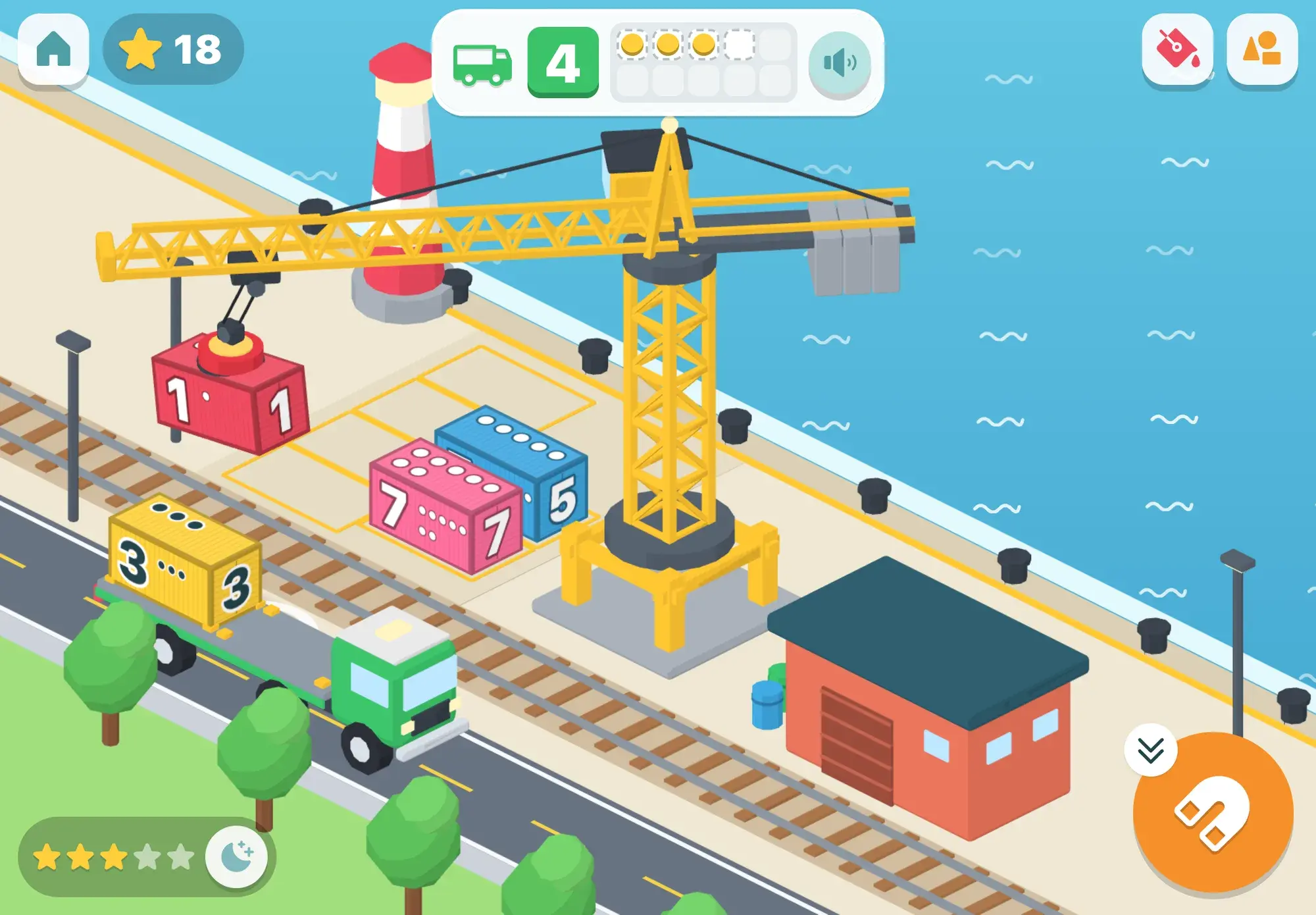
The port is a 3D crane game. A truck, a ship or a train arrives wanting a number, and your child loads numbered containers with a big yellow crane until it adds up. Each container shows its number and the same number of dots laid out like a ten-frame, and the order board fills with those dots, so 2 + 3 is something you can see. The ladder climbs step by step: finding numbers, bigger and smaller, patterns on the train, adding to five, “the same as” (two trucks carrying the same), numbers in order, adding to ten, how many more, taking away, and teen numbers with a white ten box (“Ten and three make thirteen!”). The voice says equality the other way round on purpose: “Five is the same as three and two!”
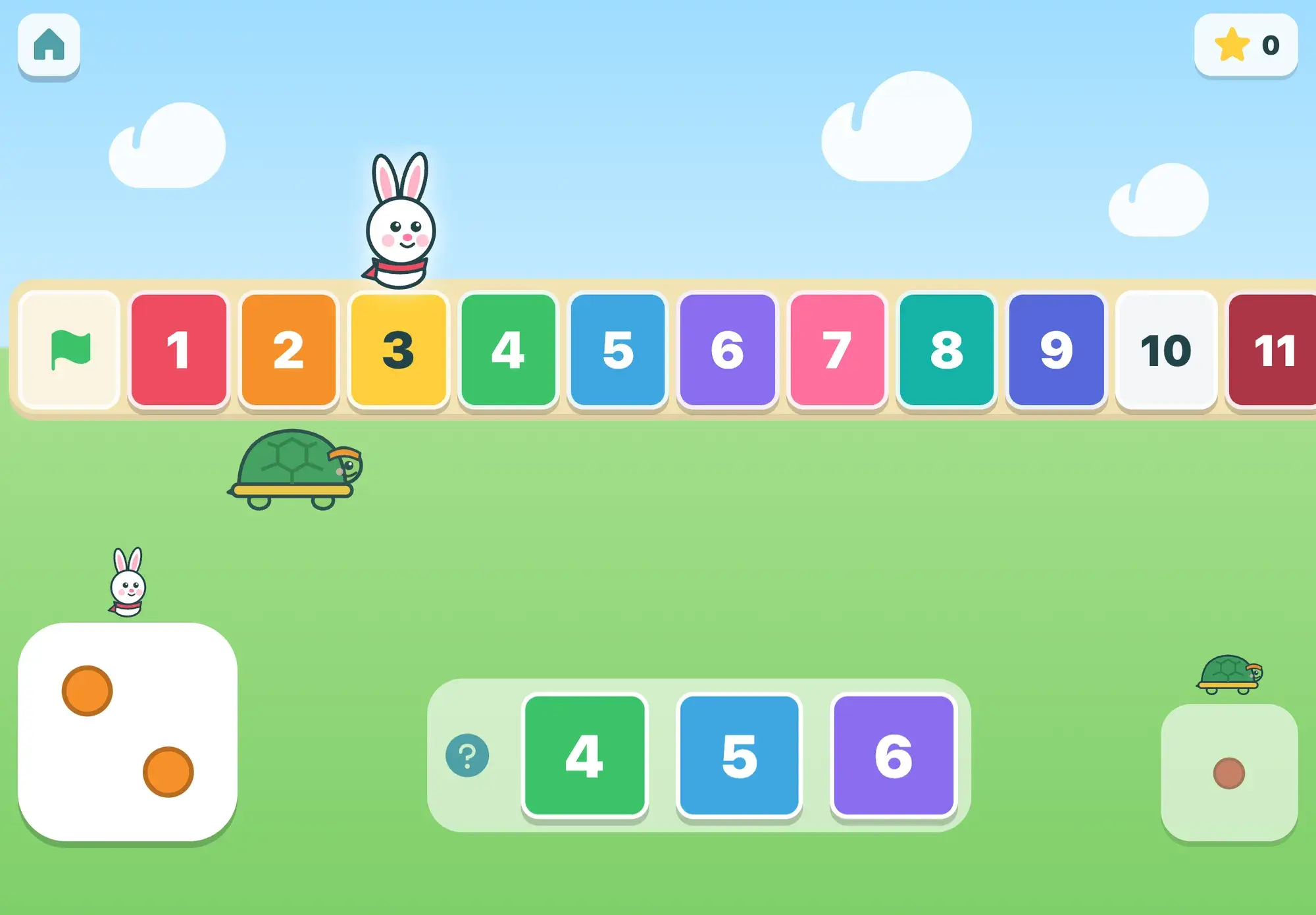
The number race is built on the straight-road board game from the research above. Your child is a bunny racing a friendly turtle, rolls a die of one or two dots, and hops square by square as each number is spoken. Later come “Where will you land?”, races to 20 and to 100 in tens, and “Where does seven go?” on an empty line marked only 0 and 10.
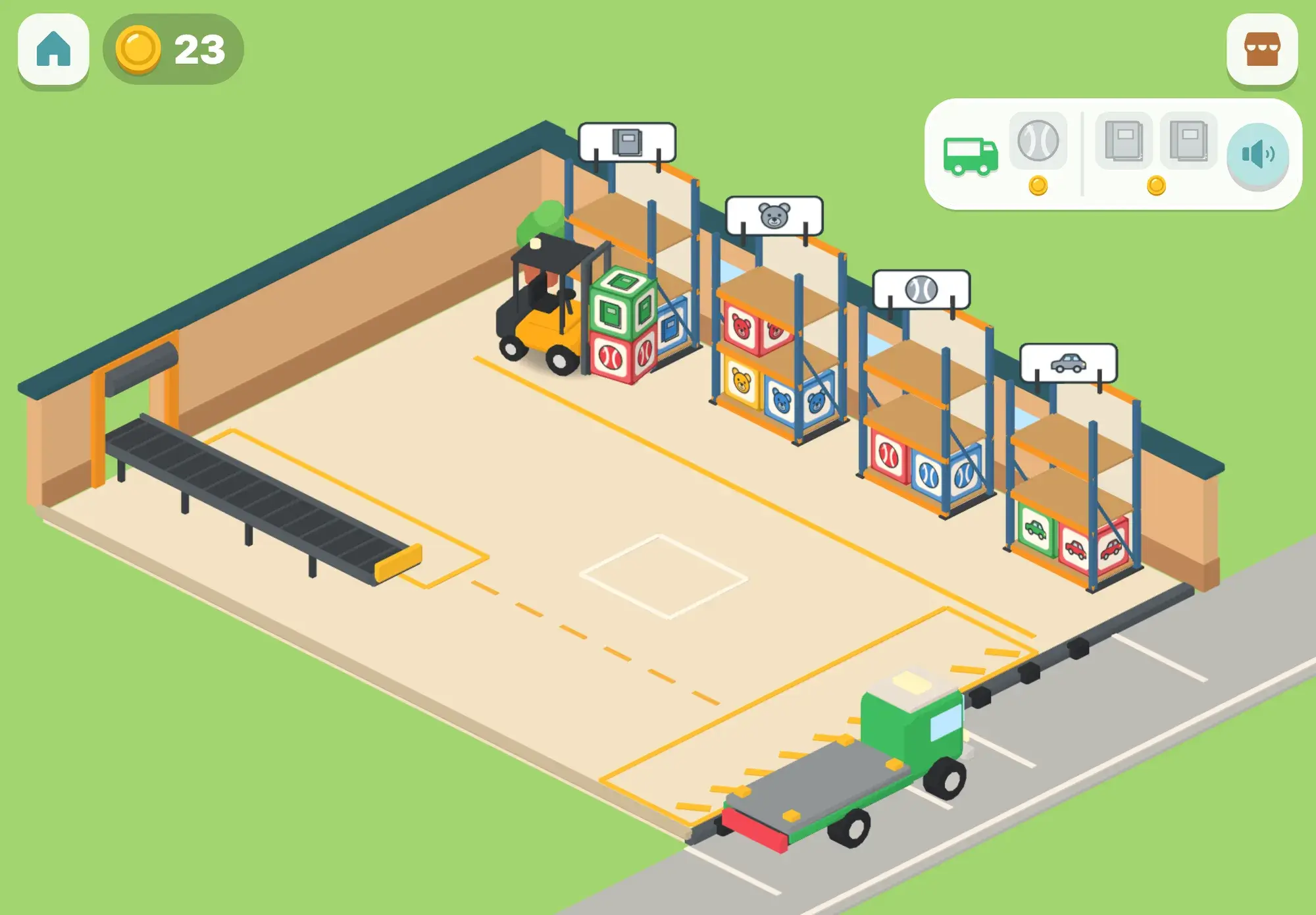
The airport (from age 4) turns the plane’s height into a number ladder from 0 to 10: “We’re at six. The ring is at eight. How many up?” The warehouse (from age 5) is sorting by color, then picture, then both, filling picture orders counted out loud, and stock checks: the order needs five, the shelf has three, how many more? For hands-on ideas beyond math, see STEM activities for preschoolers and the full list of math games for kids.