Preschoolers do science every time they ask “what happens if...?” and then try it. Good STEM activities for 3 to 6 year olds give them something real to test (a bridge that might fall, a ramp for a toy car, a seed in a cup, a leaf under a magnifier) and a grown-up who asks them to guess first and look closely afterwards. You don’t need a kit: books, tape, water, a magnifying glass and a toy car cover most of it.
What STEM looks like at 3 to 6
STEM stands for science, technology, engineering and math. At this age it isn’t worksheets or facts to memorize. It’s a loop:
- Wonder. “Will the car go farther if the ramp is higher?”
- Guess. Ask your child to say or point to what they think will happen. Science teachers call this predict, observe, explain.
- Try it. Let them do the doing.
- Look. What actually happened? Was it what they guessed?
- Talk. “Why do you think it did that?” Any answer is a good start.
The US science standards for kindergarten through second grade describe the same habits. The engineering standards (K-2-ETS1) ask young children to define a simple problem, sketch or build a model to show how an object’s shape helps it work, and compare tests of two designs. The kindergarten standards on pushes and pulls include investigating how harder or softer pushes change an object’s motion, and using ramps to change speed or direction. Preschoolers can start all of this in play.
What to expect at each age
- Around 3: explores with hands and eyes, loves cause and effect, and wants to do the same thing again and again. Repetition is the experiment.
- Around 4: starts making real guesses, sorting and comparing (“this one is heavier”), and asking “why?” constantly.
- Around 5 and 6: can compare two tries, keep a simple record by drawing, and change their design on purpose. They still need a grown-up to set up a fair comparison.
Build a bridge
Engineering is solving a problem by building something, testing it and improving it.
You need: two stacks of books, paper, tape, blocks, and a few toy cars or coins.
- Lay a sheet of paper across the gap between the stacks. Ask: “Will it hold a car?”
- Test it. It probably sags or folds.
- Ask how to make it stronger. Try folding the paper like a fan, adding a block underneath as a pillar, or using two sheets.
- Test again and compare: which bridge held more coins?
What your child practices: shape matters (a folded sheet is stronger than a flat one), a support in the middle helps a long span, and testing two designs tells you which works better.
Common mistake: fixing the bridge for them. Let it fall. A collapse that tells you something is often the most useful moment in engineering.
Dig, pour and build with sand and water
A sandbox, a beach or a baking tray of damp sand is a physics lab.
- Dig a channel from a high point and pour water in at the top. Where does it go? Water always finds the way downhill.
- Build a dam and see how long it holds.
- Compare dry and wet sand. Which one keeps the shape of a bucket? Which one slides?
- Bury a “treasure” and dig for it with a spoon, then a bigger scoop. Which is faster?
Always stay within arm’s reach when young children play with water, even a shallow tub.
Look closely: magnifiers and tiny things
A magnifying glass turns the kitchen into a field trip.
- Look at a leaf and find its veins.
- Compare salt and sugar. Salt grains look like little cubes.
- Look at a strawberry’s skin, a feather, a sponge, a piece of bread or a sweater.
- Draw what you see. Even a 4-year-old’s scribble makes them look longer.
- Sort “alive” and “not alive”. A snail, a pebble, moss, a button. The kindergarten standard on what living things need starts here: animals need food, plants need light, and all living things need water.
Never look at the sun through a magnifier, and don’t leave one lying in sunlight, where it can focus enough heat to burn.
Grow something
Plants are slow, which is exactly why they’re good for preschoolers: they teach waiting and looking every day.
- A bean in a jar. Wedge a bean between damp paper towel and the glass, so your child can watch the root come out first.
- Light or dark? Plant two identical pots. Put one on the windowsill and one in a dark cupboard. Ask your child to guess, then check every day. The dark one grows pale and thin.
- A herb pot to look after. Basil or cress on a windowsill, watered by your child, with a picture chart of who waters it when.
You set up the comparison (same seeds, same soil, same water) and your child does the guessing and the looking.
Ramps, slopes and things that move
You need: a big book or a board, a few books to prop it up, toy cars, and masking tape.
- Make a low ramp. Roll a car down and mark where it stops with tape.
- Ask: “If we make it higher, will it go farther?” Add a book and try.
- Try a heavy car and a light one from the same height.
- Try the floor, then a rug. Where does it stop sooner?
- Push a ball softly, then harder. What changes?
This is the kindergarten pushes-and-pulls standard in a living room: harder pushes, steeper slopes and smoother floors all change how things move.
More quick experiments
| Experiment | Ask first | What they notice |
|---|---|---|
| Sink or float | “Will the apple sink or float?” | Size isn’t everything: some big things float |
| Ice in sun and shade | “Which ice cube melts first?” | The sunny spot melts faster |
| Mix two paint colors | “What will yellow and blue make?” | New colors come from mixing |
| Sugar and sand in water | “Which one disappears?” | Sugar dissolves, sand sinks |
| Shadows at different times | “Where will your shadow be after lunch?” | Shadows move as the sun moves |
Common mistakes
- Explaining before they try. The answer means more once they’ve seen it.
- Correcting the guess. A wrong guess is the point. Say “Let’s find out” and “Now we know!”
- Changing several things at once. Keep comparisons simple: one difference.
- Going on too long. Ten focused minutes beats an hour of setup.
How Maestri World approaches science and engineering
Maestri World’s science games let children run experiments that would be messy, slow or impossible at home, then point them back to the real thing.
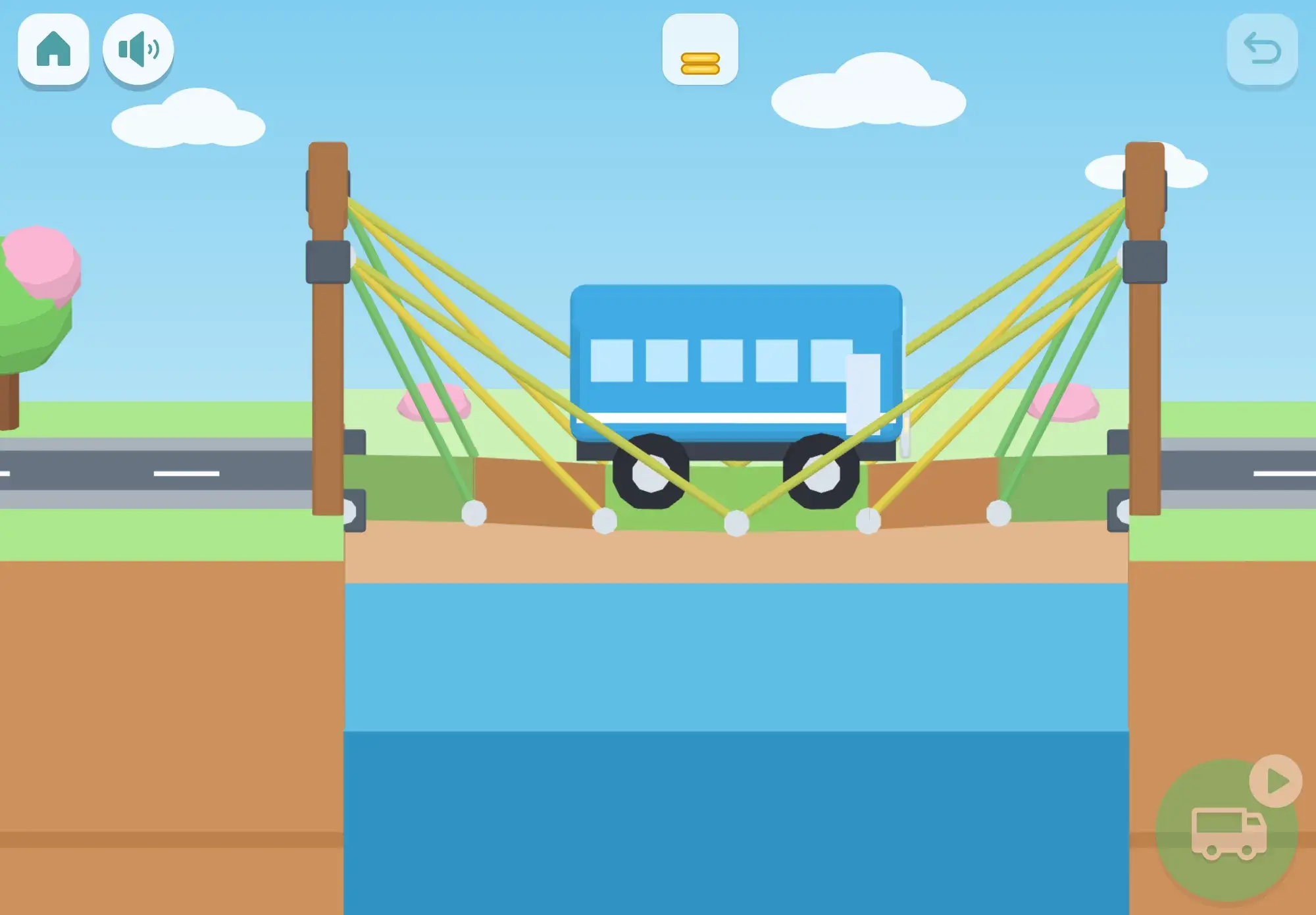
The bridge builder (from age 5): your child joins dots with planks and beams, then a truck drives across. Beams change color as they work harder, from green to yellow to red. A bridge that fails is funny, not sad: the truck floats on a ring, the moment replays in slow motion with the weak piece blinking, and the voice gives one hint. Later rivers bring triangles and a choice of wood, steel or rope.
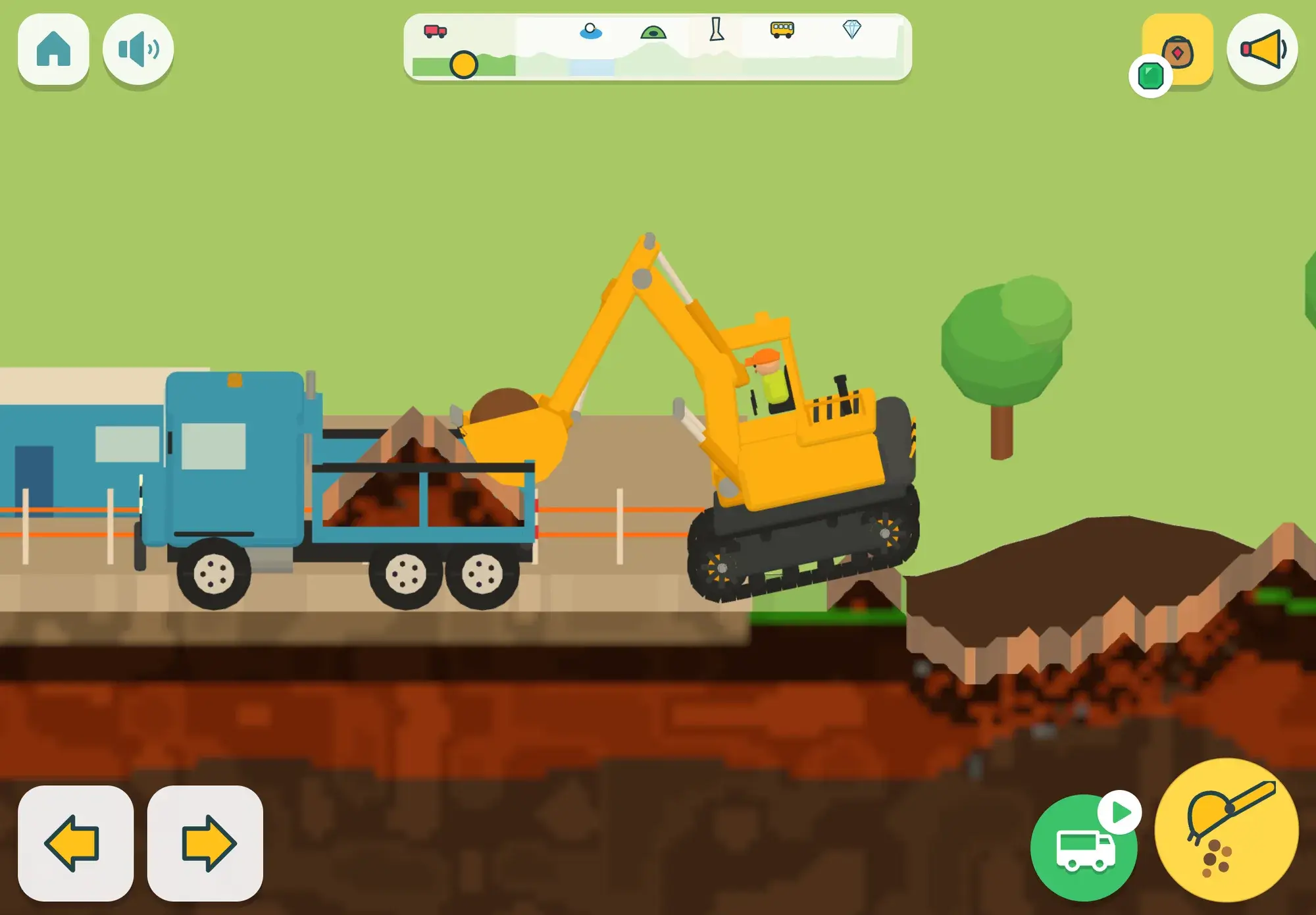
The dig site (from age 4) is a side-on world cut open like an ant farm. Your child drives a digger, and earth falls, heaps and spills, and water from the duck pond runs into a channel they dig. There are no levels or scores.
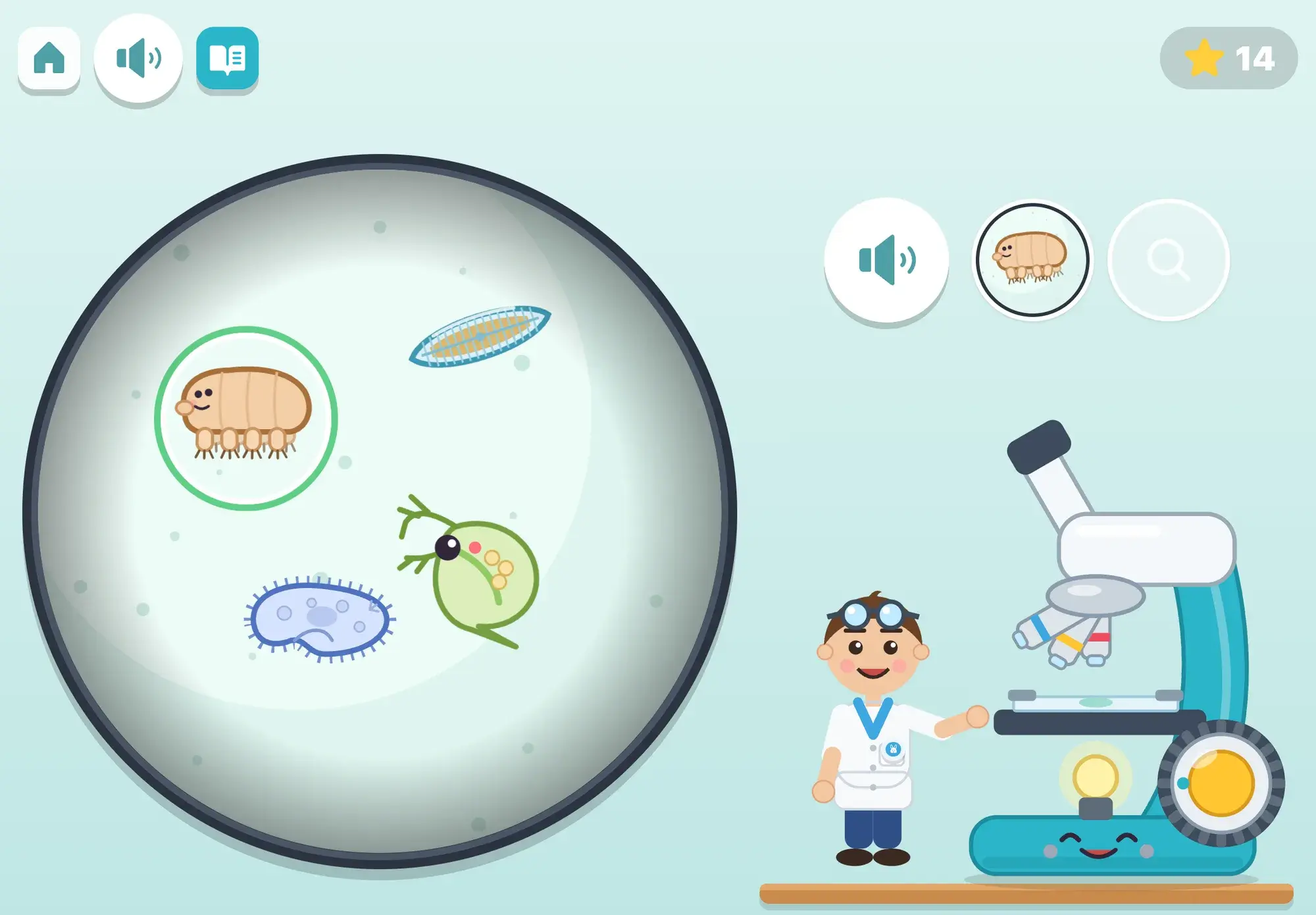
The microscope lab: turn the focus knob until a mystery close-up snaps sharp, catch the tiny swimmers in a drop of pond water, and sort alive from not alive.
Moto valley: on a little electric dirt bike, uphill needs power, downhill speeds up by itself, and mud makes stopping harder. Your child guesses first, for example whether a heavy pumpkin will go up the hill fast like a hare or slow like a snail.
The plant lab (from age 5): grow lettuce, basil or tomatoes with their roots in water, keeping water, light and plant food in the green. Halfway up, your child runs a fair test: two jars with one difference.
The break screen then sends it home: a book ramp for a toy car, or a real basil pot. More games are on our science games and engineering games pages.