Early math games for preschoolers: counting, the number line and making ten
Simple math games for 3–6-year-olds: counting objects, a straight-line board game, ten-frames, making ten, comparing, sorting and patterns, with age tips.
Read the guide
The number race
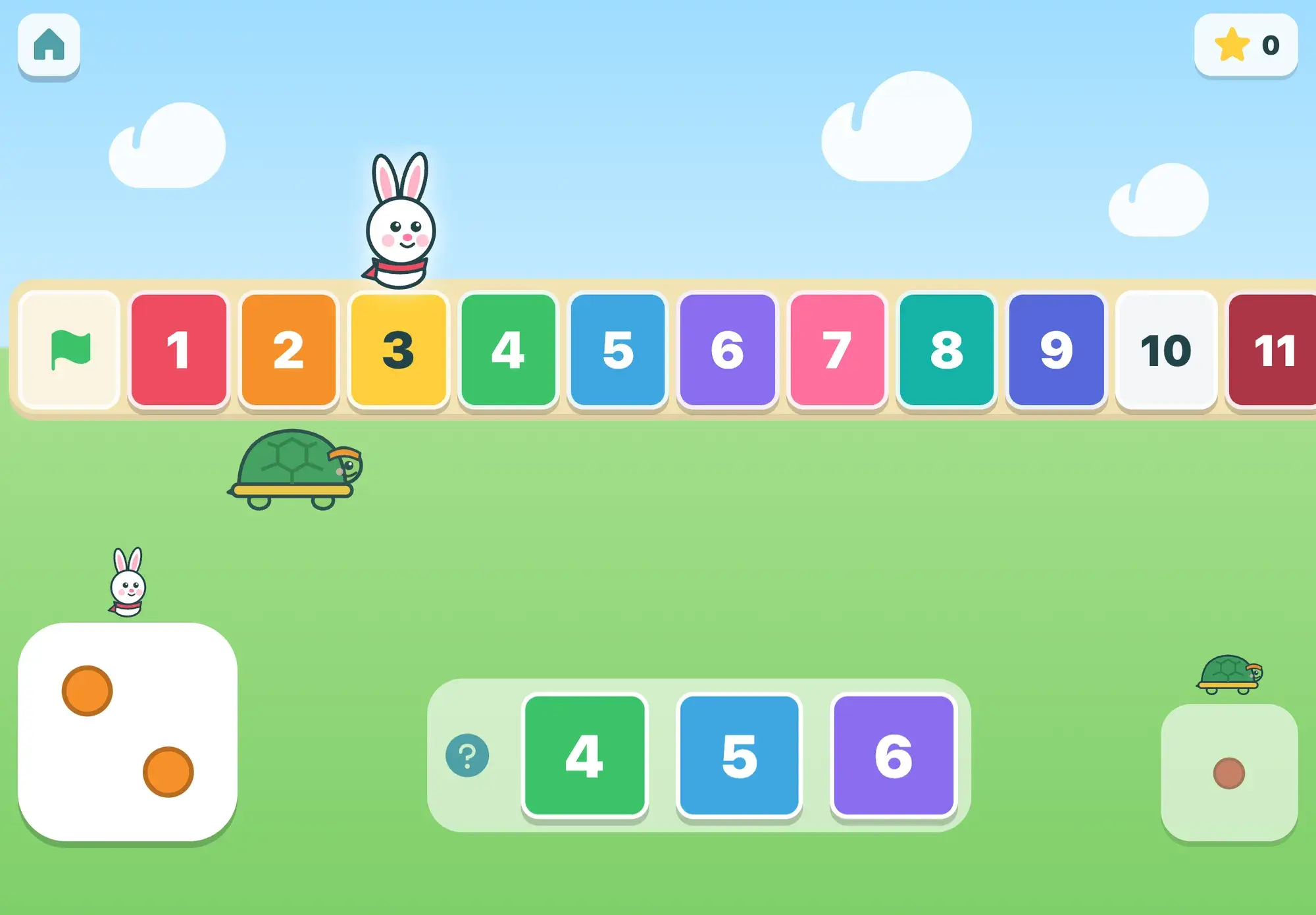
Roll, hop square by square, say each number, and race a friendly turtle

The number race is a board game on a straight road of numbered squares, running left to right. Your child is the bunny, racing a friendly turtle, and they take turns. On their turn they tap the dice (one or two dots at first), then hop one square at a time by tapping the next square. Each square says its number as they land (“five!”, “six!”), and the voice asks your child to say it too.
On the turtle’s turn, the turtle rolls and hops, counting out loud as well. A tap while it moves only gets “My turn! Wait for me.” Both pieces always reach the finish, and every race earns a star: “You won the race!”, or “Good race! Let’s race again!” when the turtle got there first. There is no losing screen.
As your child grows more sure, the road stretches from 10 to 20 and then to 100, and between races they place numbers on an empty line: “Where does seven go?”

How it plays
The road runs from 1 to 10, the dice shows one or two dots, and each square shows dots as well as its number. A tap on the wrong square says that square’s number, and the right one wiggles. At a child’s pace a race takes about a minute and a half, and three clean races open the next stage.
The dice now goes up to three. Before hopping, the voice asks: “You’re on four. Two more! Where will you land?” Your child picks one of three numbers, then hops to see if they were right, and the voice says it as a sum: “Four and two make six!”
The road reaches 20 and slides along to keep both pieces in view. The teen numbers among the “where will you land?” choices are read out, so your child hears each one while learning to recognize it. A race to 20 takes about three minutes at a child’s pace.
Between races comes an empty line marked only 0 and 10. “Where does seven go?” Your child taps a spot, then the steps appear and the right spot is shown. Landing within a tenth of the line earns a star; otherwise the voice says “Here it is!” Then the same game on lines from 0 to 20.
The last stage is a race to 100, jumping by tens. The dice shows rows of ten dots (“Two tens!”), and the number lines now run from 0 to 100. From the number-line stages on, races on the 1 to 20 road take turns with the lines, as review.
Skills
The thinking
The straight road comes from research. Siegler & Ramani (2008, 2009) had preschoolers play a board game like this, with squares 1 to 10 in a line, a spinner of 1 or 2, and saying each number while moving (at 4 with a 2: “five, six”). After about four 15 to 20 minute sessions they got better at placing numbers on a number line, comparing numbers and counting on, and later learned arithmetic faster. The same game on a circular board didn’t help: the left-to-right line is what builds the mental number line. Laski & Siegler (2014) took it to 0 to 100 with counting on.
The number race practices those skills; it doesn’t promise the same results. Your child always goes first and the turtle’s dice is a little smaller, so they win about four races in five but not every one, and never lose three in a row. The parent area shows how close their “where does it go?” guesses are, an average distance that shrinks as their number line gets straighter.
Away from the screen
Ideas to carry the game into everyday life, no screen needed.
Draw a straight road of ten squares on paper and race with buttons and a coin: heads is one step, tails is two. Say each number as you move.
Play hopscotch and count each square out loud as you land.
Hang number cards from 0 to 10 on a string between two chairs, take one away, and ask where it goes.
Bundle straws or sticks in tens with a rubber band, then count the tens up to 100.
FAQ
In the research the game is based on, the same board game helped preschoolers’ number skills when the numbers ran in a straight line, and didn’t when the board was a circle. The left-to-right road is the point.
The race is tuned so your child wins about four races in five and never loses three in a row. Both pieces always finish, every race earns a star, and when the turtle wins, the voice says “Good race! Let’s race again!”
Yes, it opens at every age. The first races only go to 10, the dice shows one or two dots, and the squares show dots too, so your child can see each number as well as hear it.
At a child’s pace, about a minute and a half for a race to 10 and about three minutes for a race to 20.
Guides
Simple math games for 3–6-year-olds: counting objects, a straight-line board game, ten-frames, making ten, comparing, sorting and patterns, with age tips.
Read the guide
More to explore


Ticket, suitcase, flight and postcard: a trip to a country your child knows

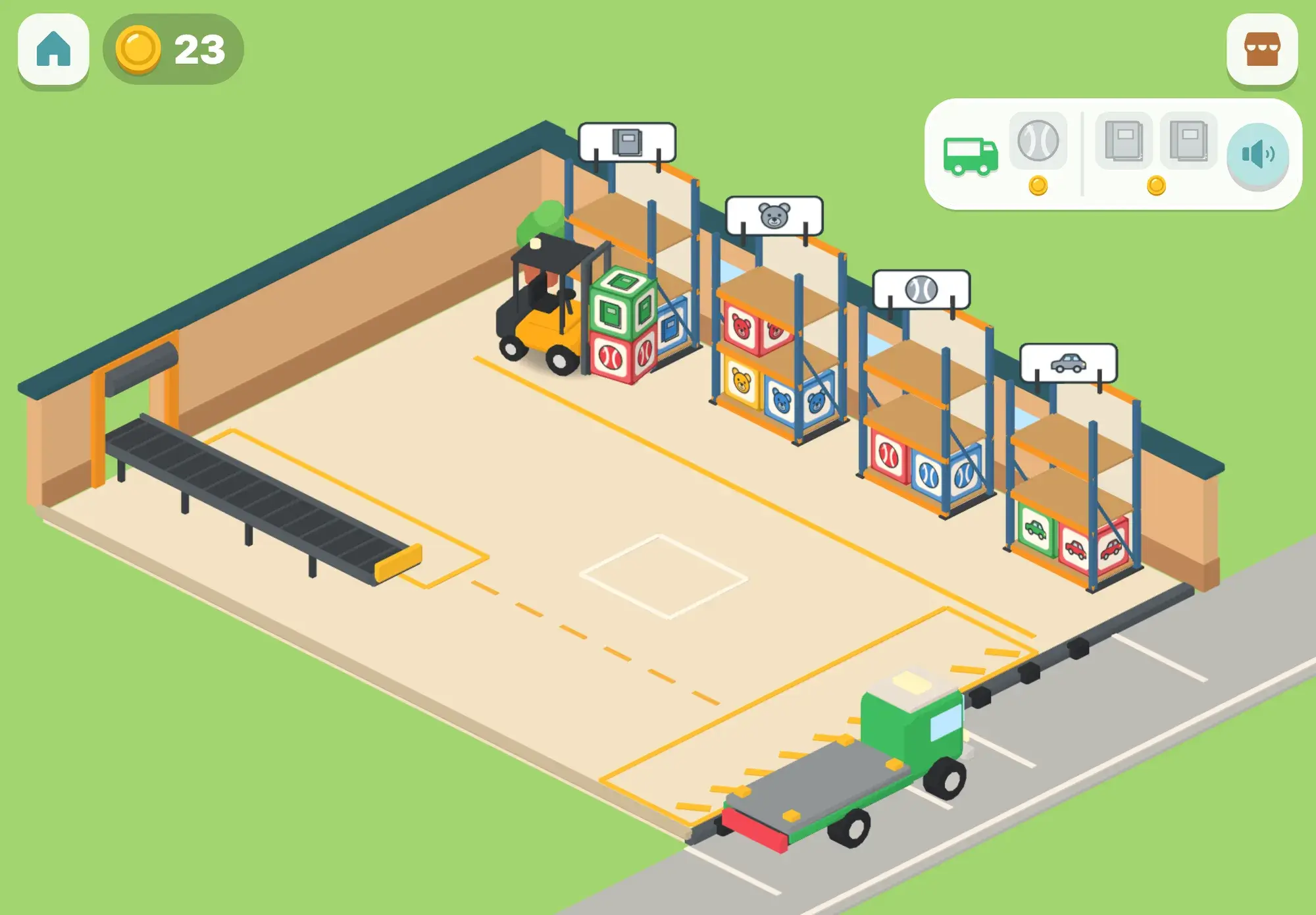
Sort the boxes, fill the trucks, and save up for a faster forklift
Spoken from the first tap, no reading needed, no ads, and progress that stays on your iPad.