Skip to content
Maestri World

The warehouse

Sorting and counting game for kids: run a 3D warehouse with a forklift

Sort the boxes, fill the trucks, and save up for a faster forklift

Ages 5–6MathLife skills
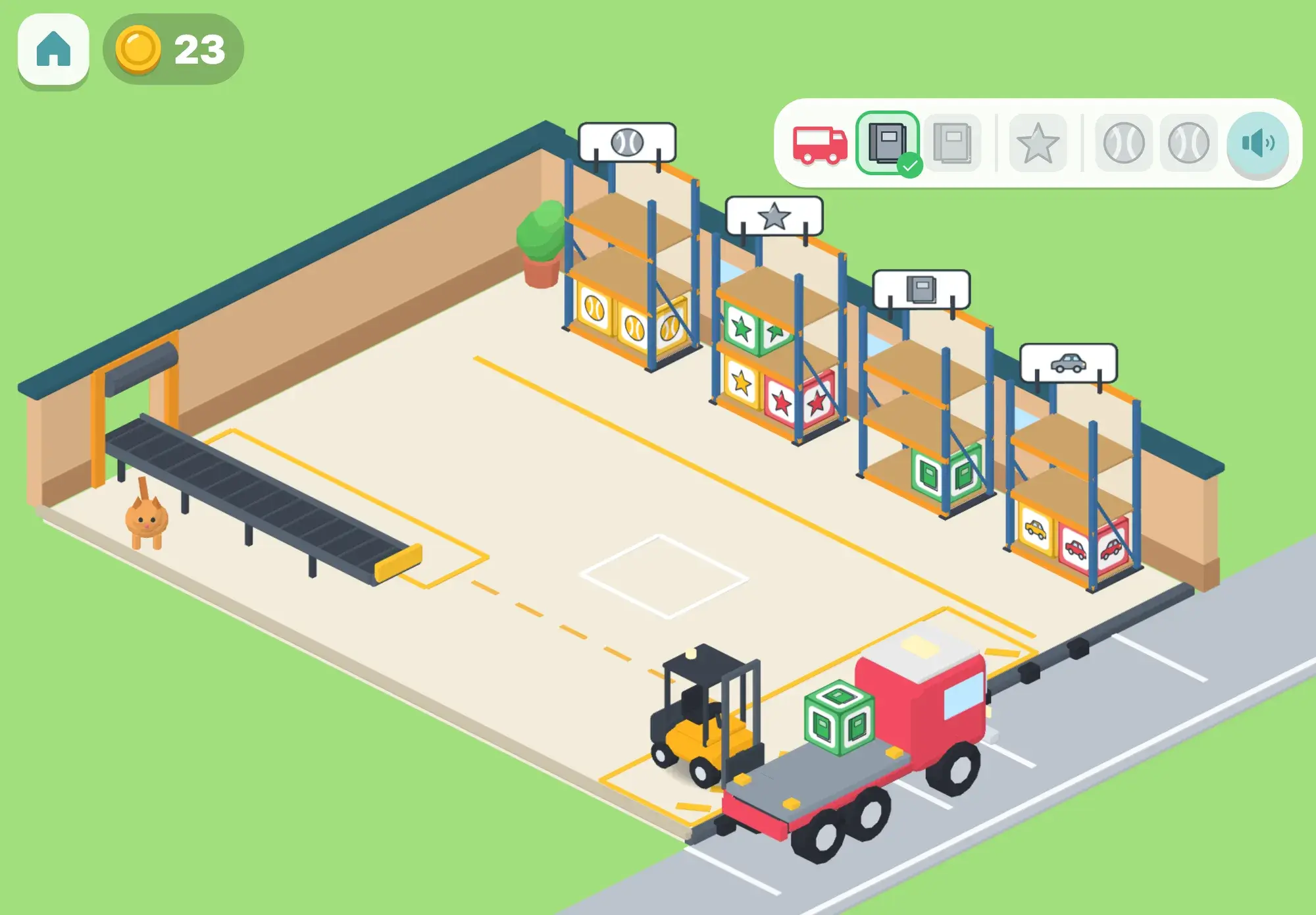
The yellow forklift carries a green book box stacked on a red ball box away from the shelves, while the order board shows the green truck still wants a ball and two books

What is the warehouse?

The warehouse is a roomy 3D building with a conveyor belt bringing in boxes, shelves along the back wall, a forklift in its parking box and trucks waiting at the dock. Your child never has to steer. They tap a box, and the forklift drives over and lifts it; they tap a shelf or a truck, and it drives there and puts the box down.

Each box has a big picture (a ball, a teddy, an apple, a car, a book or a star), a color and, later, a size. First the boxes go onto shelves by their sign. Then trucks arrive with a picture list on the order board (“This truck needs two balls. And one teddy.”), each box is counted out loud as it lands (“One ball! Two balls!”), and a full truck toots and drives off.

A wrong shelf is never a mistake on screen. The box stays on the forklift, the voice says what it is (“That’s a blue ball!”, “This truck doesn’t need a car.”) and the right shelf or truck wiggles. Every job puts a gold coin in the jar, from the very first round.

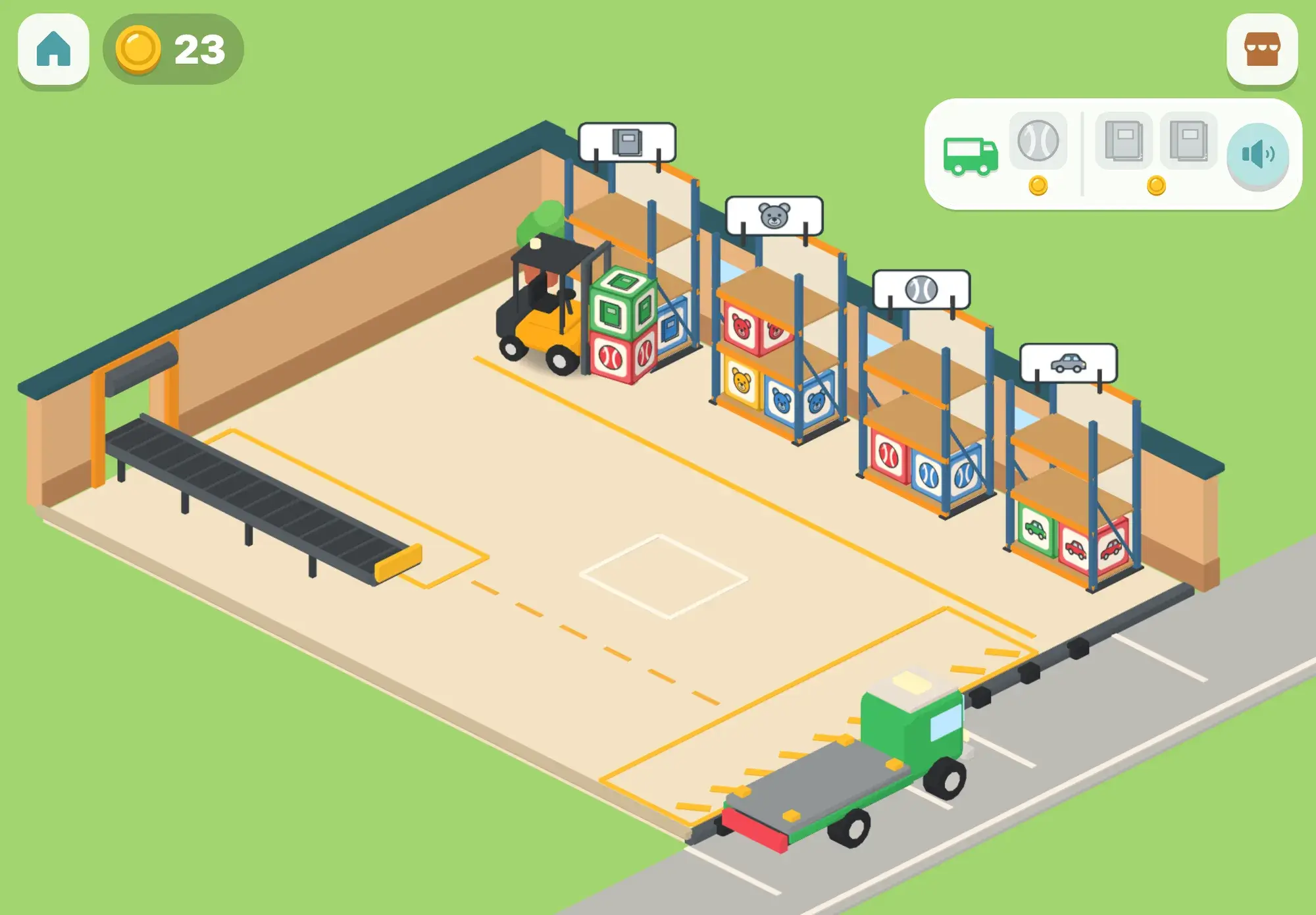
The forklift sets a green book box onto the red truck's flatbed and the order board ticks off the first book, while a ginger cat sits by the conveyor belt

How it plays

Step by step through the warehouse

  1. 1

    Sort by color, then by picture

    Five boxes onto three color shelves, each shelf painted its color. Then balls with balls and teddies with teddies, with the colors mixed so the picture is what counts. Red and green are never the two colors to sort between, because about one boy in twelve can’t tell them apart.

  2. 2

    Sort by two things

    Four shelves: red balls, blue balls, red cars and blue cars, or big and little balls and cars. Each box fits exactly one shelf, so your child has to look at two things at once before choosing where it goes.

  3. 3

    Fill the orders

    First come one-box orders (“A teddy for this truck!”), then orders of up to five boxes in two or three kinds, ticked off and counted as they load. One too many is stopped with “We have enough balls!”, so counting to the right number is what fills the truck.

  4. 4

    Stock check and two trucks

    The order needs five, but the shelf has three: “How many more do we need?” Your child picks a number on the delivery board, and a wrong one says what it would make (“Three and three make six. That’s too many!”). Later the forklift carries three boxes and two trucks wait; dashed rings show the fewest trips, and doing it in that many earns a bonus star.

  5. 5

    Market day and the shop

    Trucks now pay for every box: balls, apples and books one coin, cars and teddies two, stars and ducks three. The shop sells a faster forklift (6 coins), paint (10), a shelf of rubber ducks (15) and a second dock (20). Tapping something your child can’t afford yet says how many more coins it needs and makes it the saving goal.

Skills

What your child learns

  • Sorting by one property, color or picture, and then by two at once.
  • Matching one box to each picture on an order (one-to-one correspondence).
  • Counting up to five while loading, and knowing when there are enough.
  • Working out how many more are needed: “we have three, we need five.”
  • Planning a job so it takes as few trips as possible.
  • Counting coins and seeing whether there are enough for something.
  • Choosing between spending now and saving for something bigger.

The thinking

Why it works

Sorting by one property and then by two (classification) and matching objects one to one are core early math skills between four and six; they are steps in the early math learning trajectories (Clements & Sarama 2009), and one-to-one correspondence is the first of the counting principles (Gelman & Gallistel 1978). “We have three, we need five” is a missing-addend problem, which young children solve by counting on before they are taught subtraction (Carpenter & Moser 1984). Planning fewer trips is planning ahead, an executive-function skill that grows quickly from four to seven (Luciana & Nelson 1998).

Saving coins for a bigger upgrade practices waiting for a bigger reward, which depends on trusting that the reward will come (Kidd, Palmeri & Aslin 2013). So the shop keeps its promises: prices never change, coins are never lost, and buying or saving is always your child’s choice. Real saving strategies are hard for young children and develop slowly through the school years (Sonuga-Barke & Webley 1993), so this is a gentle start, not a lesson. To be honest about it: this is practice of these skills in play, not a business course, and nobody has shown that a game like this makes children better at them elsewhere.

Away from the screen

Keep it going at home

Ideas to carry the game into everyday life, no screen needed.

  • Sort the laundry together: first by color, then by color and whose it is.

  • Unpack the groceries onto shelves by kind: fruit here, cans there.

  • Set the table and ask how many more forks you need: “We have three, we need five.”

  • Keep a real coin jar for a small goal, with a picture of the goal on it, and count the coins together now and then.

FAQ

Questions about the warehouse

What age is the warehouse game for?

It opens from age 5, based on your child’s birth month, and a parent can show it earlier or hide it. The first rung is simple color sorting; numbers and coins come in gradually.

What happens if my child puts a box in the wrong place?

Nothing goes wrong on screen. The box stays on the forklift, the voice says what it is, and the right shelf or truck wiggles. A box that doesn’t belong is never picked up, so there is nothing to undo.

Is it about money?

Only gently. Coins are earned for jobs in the game and spent in the warehouse’s own shop on things like a faster forklift. Each price is a row of coin spaces filled from the jar, so “enough” and “how many more” can be seen.

Does it teach subtraction?

Not as a written sum. The stock check asks “How many more do we need?”, which children this age solve by counting on, a step before subtraction is taught.

Guides

Read more

More to explore

Kids who like this also play

The yellow crane lowers a red container marked 1 onto a green truck already carrying a 3, and the order board asks for 4

Trucks want a number. Your child loads containers until it adds up.

Ages 3–6Math
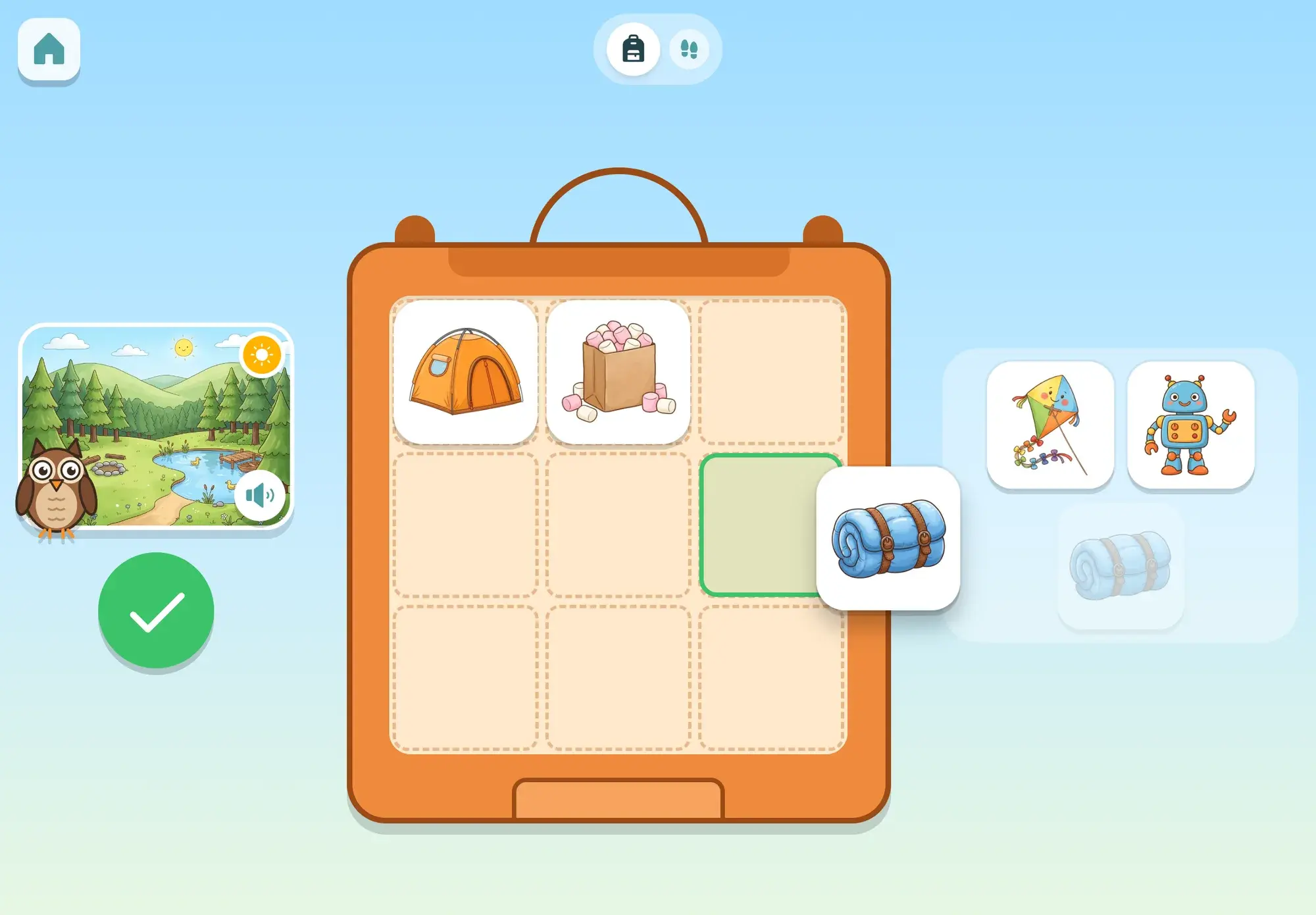
Packing for a camping trip: the tent and the marshmallows are in the backpack and the sleeping bag is being dragged in, while a kite and a toy robot wait on the shelf

Pack what the trip needs, make room for a toy, and count coins at the shop.

Ages 5–6Life skillsShapes & spatial
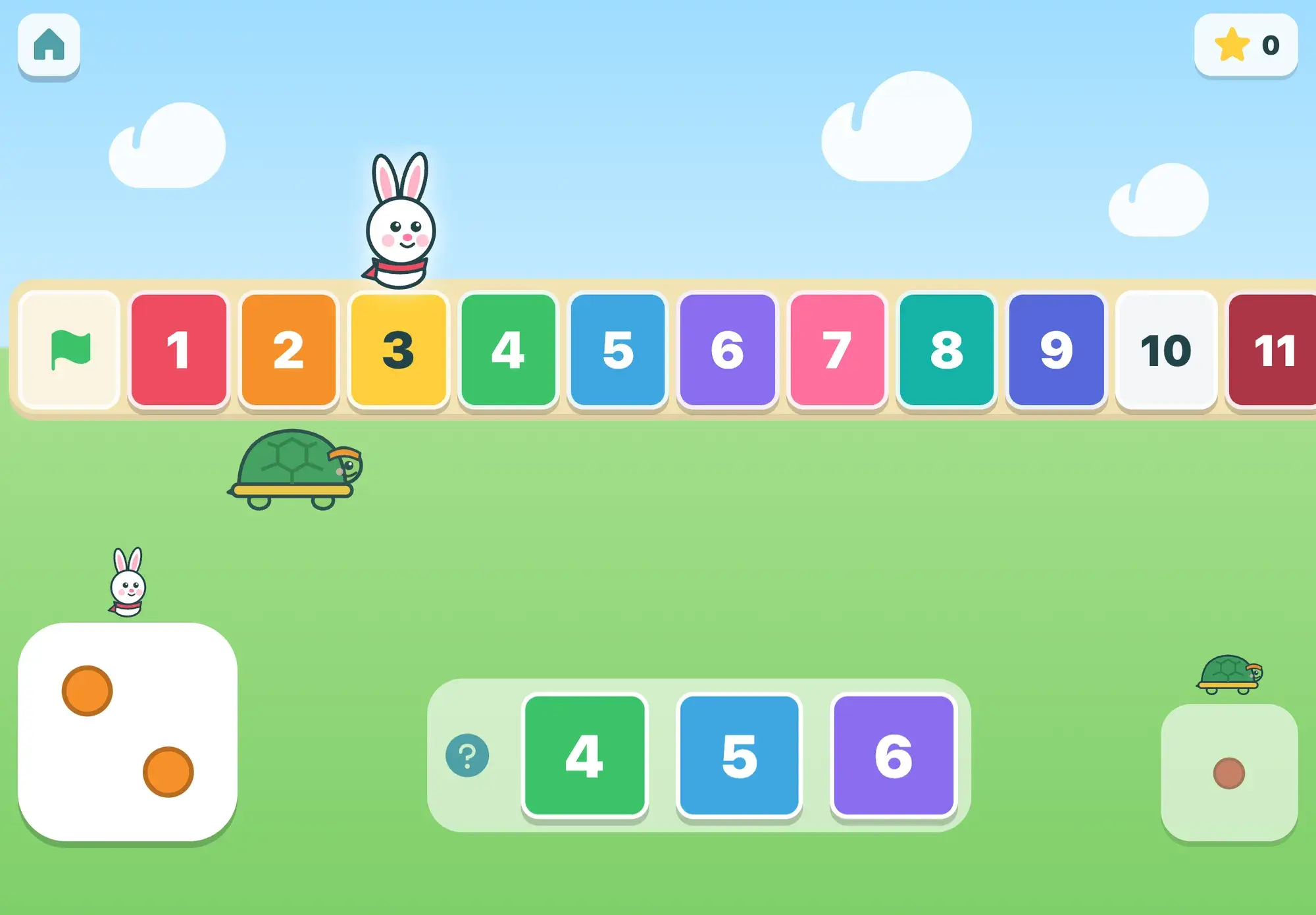
The bunny sits on square 3 of a colourful 1-to-20 number track ahead of the turtle, the dice shows two dots, and the child picks where the bunny lands from 4, 5 or 6

Roll, hop square by square, say each number, and race a friendly turtle

Ages 3–6Math

A whole town of learning, ready when your child is

Spoken from the first tap, no reading needed, no ads, and progress that stays on your iPad.