For children aged 3 and 4, the World Health Organization recommends no more than one hour a day of sedentary screen time, and says less is better. Pediatricians add that what a child does on a screen, and who they do it with, matters as much as the minutes. For most families that means a short, planned session of good content, ideally with a grown-up nearby, that ends at the same point in the day.
This guide covers what the main guidelines actually say, how to judge quality, how to play together, and how to end a session without tears.
What the guidelines actually say
Two sources come up again and again, and they say slightly different things.
| Source | Who it covers | What it says |
|---|---|---|
| WHO guidelines, 2019 | Children under 5 | Ages 3–4: no more than 1 hour of sedentary screen time a day, less is better. At least 180 minutes of physical activity, at least 60 of them moderate to vigorous. 10–13 hours of good sleep. |
| American Academy of Pediatrics, “5 C’s” for toddlers and preschoolers | Toddlers and preschoolers | No single number. Choose high-quality content, keep screens for regular times of day, don’t use a device every time a child is upset or bored, avoid open access to a tablet, and talk about what they watch. |
The WHO guideline treats screen time as one part of a whole day: lots of moving, good sleep, and not too long sitting still. The AAP’s parent guidance is built around five questions, the “5 C’s”: your child, the content, how they calm down, what screens crowd out, and how you talk about it.
Limits still matter. In a Q&A for pediatricians, the AAP says boundaries and balance are important so that kids get sleep, play and time with their family. It names three things as most important: content that is worth a child’s attention, daily chances to laugh, play, read and move, and grown-ups who help children understand and manage their feelings.
The WHO guideline above stops at the fifth birthday. For 5- and 6-year-olds the same principles carry on: screens shouldn’t push out sleep, outdoor play or time together.
Quality matters as much as quantity
Twenty minutes of building a bridge, sorting foods or tracing letters is not the same as twenty minutes of autoplay videos. A few things separate good screen time from filler:
- Your child does something. They choose, build, sort or answer, instead of only watching.
- No ads and no pressure. Pop-ups, “watch a video to unlock this” and characters who beg your child to stay all work against you.
- A clear end. A game with rounds, or a show with an ending, is easier to stop than an endless feed.
- It connects to real life. Good sessions spill over: a child who sorted fruit on a screen wants to sort the shopping.
If you’re comparing apps, our checklist for choosing a learning app goes through this in more detail.
A common mistake is treating the word “educational” as a pass. Many apps marketed as learning still come with ads, pressure to keep playing and noise. Play it yourself for ten minutes before your child does.
Play together, even for five minutes
The AAP’s parent site puts it simply: children learn more about media when they share the experience with an adult. You don’t have to sit through every session. Small moments count:
- Sit with your child for the first few minutes of a new game, until they know how it works.
- Ask about what they’re doing: “Why did you put the beam there?” works better than “Are you winning?”
- Let them teach you. Explaining a game to a grown-up is good practice for a 5-year-old.
- Carry it off the screen. If they counted containers in a game, count the spoons at dinner.
Co-play also tells you whether the content is right for your child: too hard, too easy, too exciting, or just right.
Build screens into the routine
Children cope better with limits they can predict. The AAP suggests keeping screens for regular times of day rather than whenever someone is bored.
- Pick a slot. After lunch, or while dinner is being made, at the same time each day.
- Keep some times screen-free. Meals, the car on short trips, and the hour before bed. The AAP’s sleep advice is to turn off all screens at least an hour before bedtime and keep them out of bedrooms, especially at night.
- Decide before, not during. “One session after lunch” is a rule. “We’ll see” is a negotiation.
What to expect at each age varies a lot, but roughly:
- Around 3: short attention, big feelings at transitions. A grown-up nearby helps, and sessions go better when they’re short and end at a natural stop.
- Around 4: can follow a simple routine (“after snack, then the tablet”) and starts to understand “one more game”.
- Around 5 and 6: can help make the family rules, understand a timer, and talk about what they played. This is a good age to agree the rules together and write them down.
How to end a session without a meltdown
Most transitions are less dramatic than they feel. In a 2016 University of Washington study, researchers interviewed 27 families of children aged 1 to 5 and followed 28 more with diaries. Parents described about 59% of transitions as neutral, 19% as positive and 22% as negative. Two findings stand out:
- Two-minute warnings made things worse. Children were more upset when told the end was coming soon, which surprised the researchers.
- Some things made it easier: a regular routine, a natural stopping point in the game or show, and the technology itself being the reason (the battery ran out, the episode ended).
It’s one study, so treat it as a hint rather than a law. In practice, these steps help:
- Agree on the end before you start. “Two games, then we go outside.”
- Stop at a natural stopping point. The end of a round, a game or an episode, not in the middle of one.
- Have the next thing ready. A snack, the park, the bath. Ending is easier when there’s somewhere to go.
- Let the routine do the work. If screens always end when lunch is on the table, nobody has to argue.
- Name the feeling, keep the limit. “You wanted to keep building. It’s hard to stop. We can build more tomorrow.”
- Don’t make screens the only way to calm down. The AAP suggests not reaching for a device every time a child is upset or bored, so they learn other ways to settle.
Common mistakes: “just five more minutes” that turns into thirty, taking the tablet away mid-game as a punishment, and rules that change depending on how tired the grown-up is. Consistency is kinder than strictness.
How Maestri World approaches screen time
Maestri World is an iPad app of learning games for children who can’t read yet, so we had to decide how a session ends.
You choose the session length in the parent area, or switch the break off. Near the end, when your child comes back to the town, the voice says once: “One more game, and then it is time for a break!” The end is tied to a game finishing, not a countdown.
The break screen gives a mission to do at home with a grown-up, usually about something just learned: find three things that start with a new sound, line up and count toys, a freeze dance. Once your child has played Bo’s cabin, it can be putting a teddy to bed like Bo. A line underneath tells the grown-up what it’s for. A grown-up can choose to carry on, and the parent area shows how often that happened.
No streaks, no red counts, no timers that run out. Nothing breaks if your child skips a day. The daily trip’s reward is a garden where waiting overnight grows a bigger plant, and plants never wilt.
A parent area with the real picture. Behind a grown-up gate (hold the gear, then solve a written sum) you see minutes per day over 12 weeks, the time of day your child plays, session lengths and time per subject.
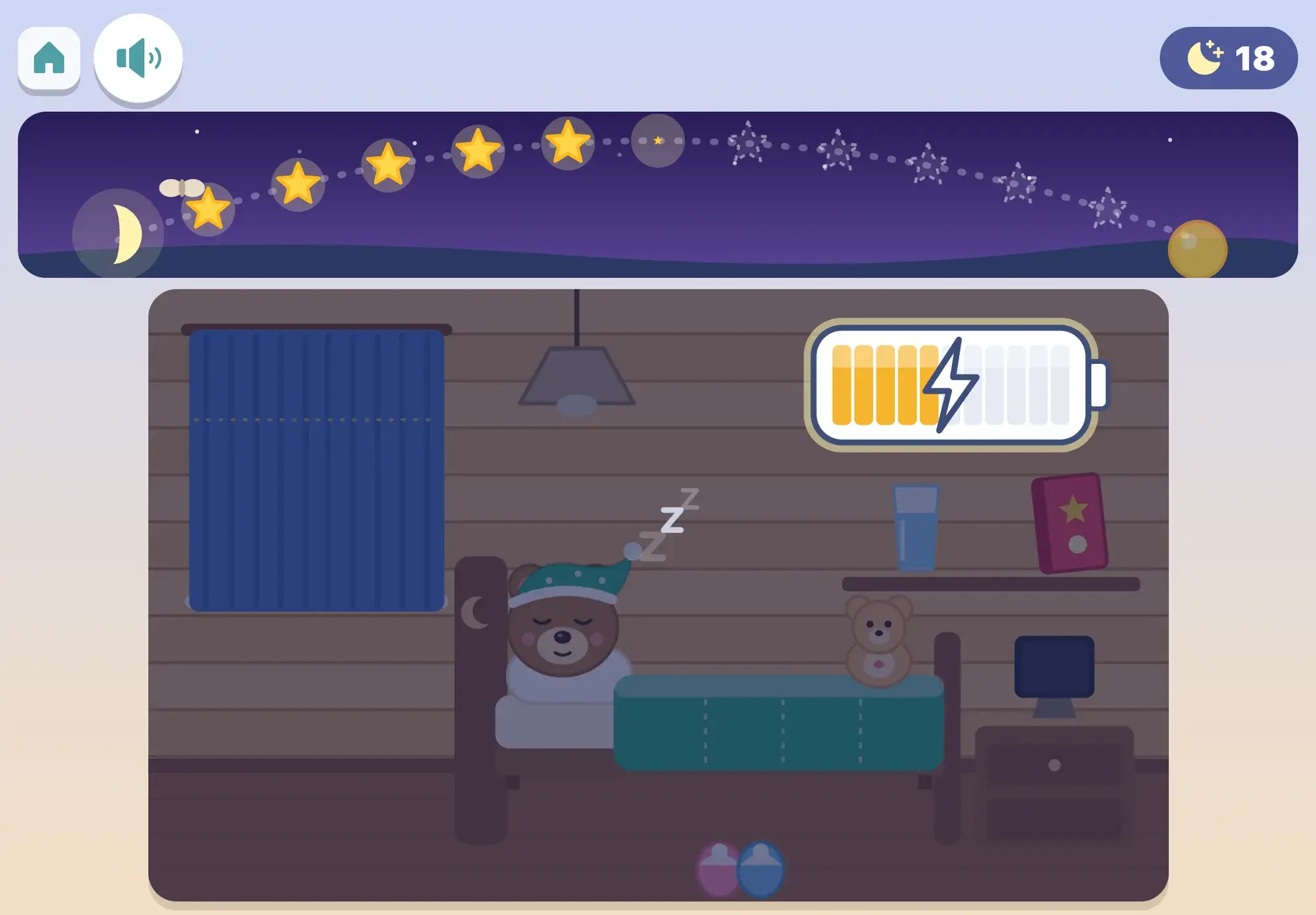
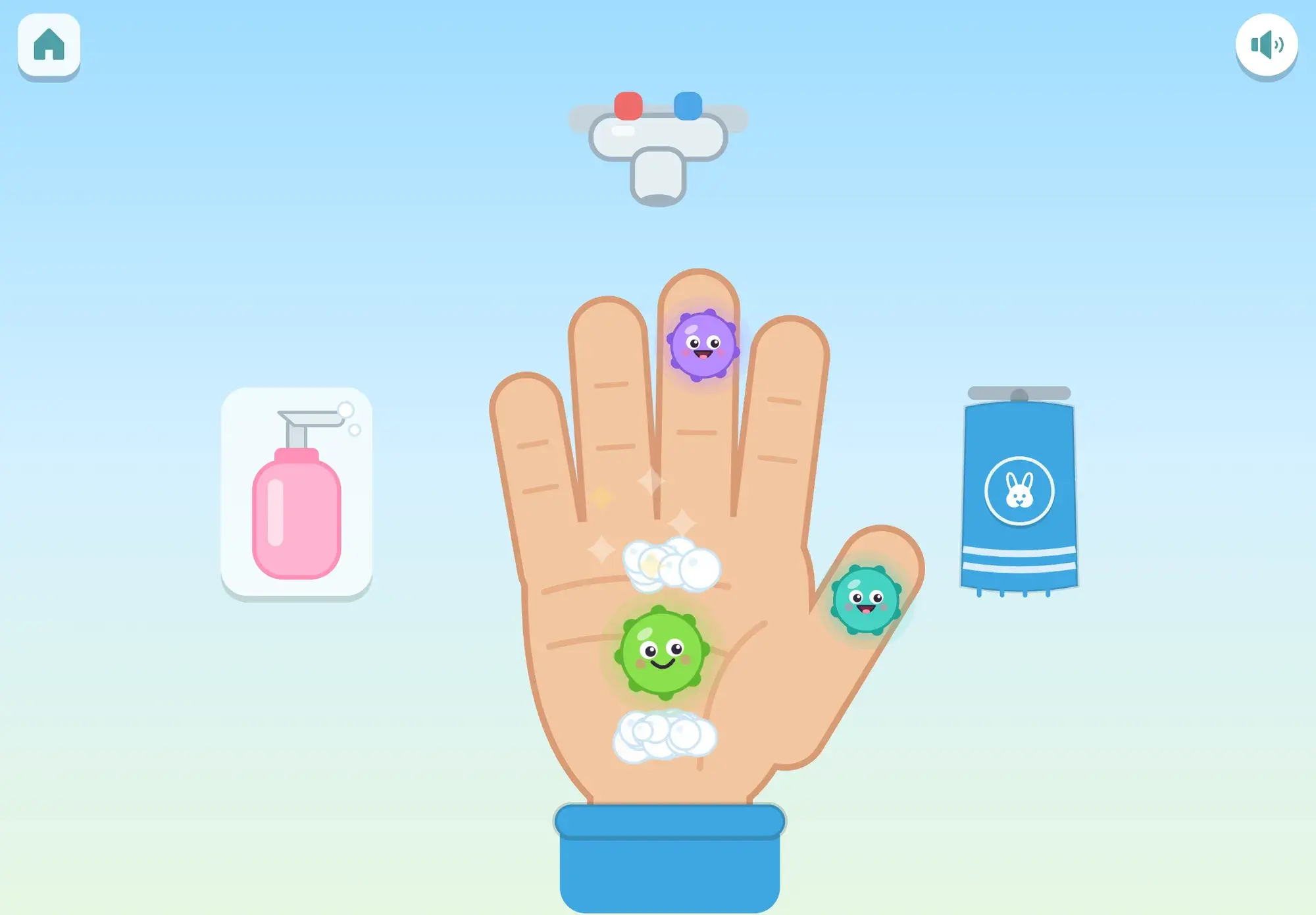
Screens and sleep, taught through play. In Bo’s cabin, children get a little bear’s room ready for the night and learn “Screens off one hour before bed.” The game never locks or nags at your real bedtime. In Our house, the bedroom plays your family’s own night routine, in the order you set. For more on sleep, food and handwashing, see our guide to healthy habits for kids.
The short version
- For 3- and 4-year-olds, the WHO says up to an hour a day of sedentary screen time, and less is better.
- What your child does on screen, and whether you join in, matters as much as the minutes.
- Fix a time of day, keep meals and the hour before bed screen-free, and decide the end before you start.
- End at a natural stopping point and have the next thing ready. Warnings help less than routines.