Phonics usually starts with a small set of letter sounds such as s, a, t, p, i and n because those six sounds are easy to say, look different from one another, and already make lots of real words: sat, tap, pin, nap, tin, sit. A child who knows just these can sound out a word and read it, which is the whole point of the order. At home, you can practice the same way: teach the sound (not the letter name), say it short and clean, and play with it in real words every day for a few minutes.
Sounds first, names later
Phonics teaches what a letter says, not what it’s called. The letter m says “mmm”. Its name, “em”, starts with a different sound, and a child who blends names gets “em-ay-tee” instead of “mat”.
England’s Letters and Sounds program, published by England’s education department in 2007, teaches the sounds first and brings in the letter names later (with the alphabet song) once children know what the letters say. The alphabet song is still lovely to sing; it just isn’t how reading starts.
Start with lowercase letters, too. Nearly every letter in a picture book is lowercase, so that’s what your child needs to recognize first. Capitals can wait, apart from the first letter of their own name.
Why s, a, t, p, i, n come first
Look at what those six letters can do. With s, a, t and p alone your child can read at, sat, pat, tap and sap. Add i and n and the list grows quickly: pin, tin, sit, nip, pit, sip, tip, nap, pan, tan, ant and spin. Letters and Sounds suggests clapping out exactly these kinds of words (sat, pin, nip, pat, tap, pit, pip) while children are still learning to hear sounds.
The order has a few other quiet advantages:
- Real words from week one. Reading a word yourself is what makes the effort feel worth it.
- One vowel at a time. Only a at first, then i, so there’s less to mix up in the middle of a word.
- Sounds you can stretch. s, a, i and n can be held (“sssaaat”), which makes it easier to hear them run together into a word.
- Mirror letters kept apart. In Letters and Sounds, d arrives in the second week and b in the fifth, so the classic b and d mix-up isn’t built in from the start.
Other phonics programs shuffle the first letters a little. The principle matters more than the exact list: a few common sounds that quickly make words, then more.
The full order, set by set
Here is the Letters and Sounds order. In school it suggests one set a week. At home with a preschooler there’s no need to go that fast.
| Set | Sounds | Words you can make |
|---|---|---|
| 1 | s, a, t, p | at, sat, tap, pat |
| 2 | i, n, m, d | pin, man, sit, dad |
| 3 | g, o, c, k | dog, cat, kit, top |
| 4 | ck, e, u, r | duck, red, sun, rock |
| 5 | h, b, f, ff, l, ll, ss | hat, bed, fan, bell, miss |
| 6 | j, v, w, x | jam, van, web, box |
| 7 | y, z, zz, qu | yes, zip, buzz, quiz |
After that come the two-letter sounds: ch, sh, th and ng, then ai, ee, igh, oa and oo, and later ar, or, ur, ow, oi, ear, air, ure and er. Along the way children meet a few “tricky words” that can’t be sounded out yet, such as the, to, go and no. These are simply remembered.
Say the sounds pure
If there’s one habit worth getting right, it’s this one. Letters and Sounds is direct about it: don’t add an “uh” to the end of a sound. Say “ssss”, not “suh”; “mmm”, not “muh”; “t”, not “tuh”.
The reason is blending. “Cuh-a-tuh” doesn’t run together into “cat”, but a short, clean “c-a-t” does. If you’re unsure, say the word slowly and listen for where your mouth is at each sound: the t in “cat” is a tiny puff, not a syllable.
Listening comes before letters
Before letters mean anything, children need to hear the sounds inside words. These games suit most three-year-olds and keep helping long after:
- Rhymes. Read rhyming books and leave out the last word: “The cat sat on the...”
- Clapping beats. Clap the syllables of names and words: “ba-na-na” is three claps.
- I spy with sounds. “I spy something that starts with mmm.”
- Sound-talk. Say the last word of a sentence in sounds and let your child put it together: “Can you touch your f-ee-t?” Letters and Sounds suggests a toy that can only speak in sound-talk, and letting it get a word wrong now and then so children can catch it out.
Practicing letter sounds at home
A few minutes a day beats a long session once a week. Some ideas:
- Sound of the week. Introduce one sound and find it everywhere: three things in the kitchen that start with sss, a sign on the street with an s.
- Trace it big. Draw the letter in sand, in shaving foam on the table or with a finger on your child’s back, saying the sound as you go.
- Magnetic letters. Put out s, a, t and p. Build “sat”, then swap the s for a p: “pat”. Changing one letter at a time shows how words are made.
- Sound hunt in a book. “Can you find an a on this page?”
- Choose clean example words. “Mmm, moon” is a good example. “K is for knife” or “u is for unicorn” aren’t, because those words don’t start with the sound the letter usually makes.
- Little books made of known sounds. Once your child can blend a few words, short books that use only the sounds they know let them read a whole page themselves. These are often called decodable books.
- Keep reading aloud. Stories for the joy of them are separate from phonics practice and just as important.
What to expect at each age
There’s wide variation, and earlier isn’t better. Roughly:
| Age | What’s typical to work on |
|---|---|
| 3 | Rhymes, clapping syllables, enjoying books, maybe recognizing the first letter of their own name |
| 4 | Hearing the first sound of a word, learning letter sounds one by one, blending two or three sounds out loud |
| 5 | Sounding out short words like sat, pin and dog, first two-letter sounds such as sh |
| 6 | More two-letter sounds, longer words, reading short books more smoothly |
Letters and Sounds expects that by the end of its first letters phase (sets 1 to 5), many children can read and spell some short words like “at” and “sat”. That’s a goal for a school class, not a deadline for a preschooler.
Common mistakes
- Adding “uh” to the sounds. It makes blending much harder.
- Teaching in alphabetical order. a, b, c, d is a list, not a teaching order. It brings b and d together and makes few words early.
- Capitals first. Books are mostly lowercase.
- Moving on too fast. A new sound every day with no going back means the early ones slip. Revisit old sounds often.
- Turning it into drills. If your child is wriggling away, stop and try again tomorrow. A short, happy round does more than a long, tense one.
How Maestri World approaches it
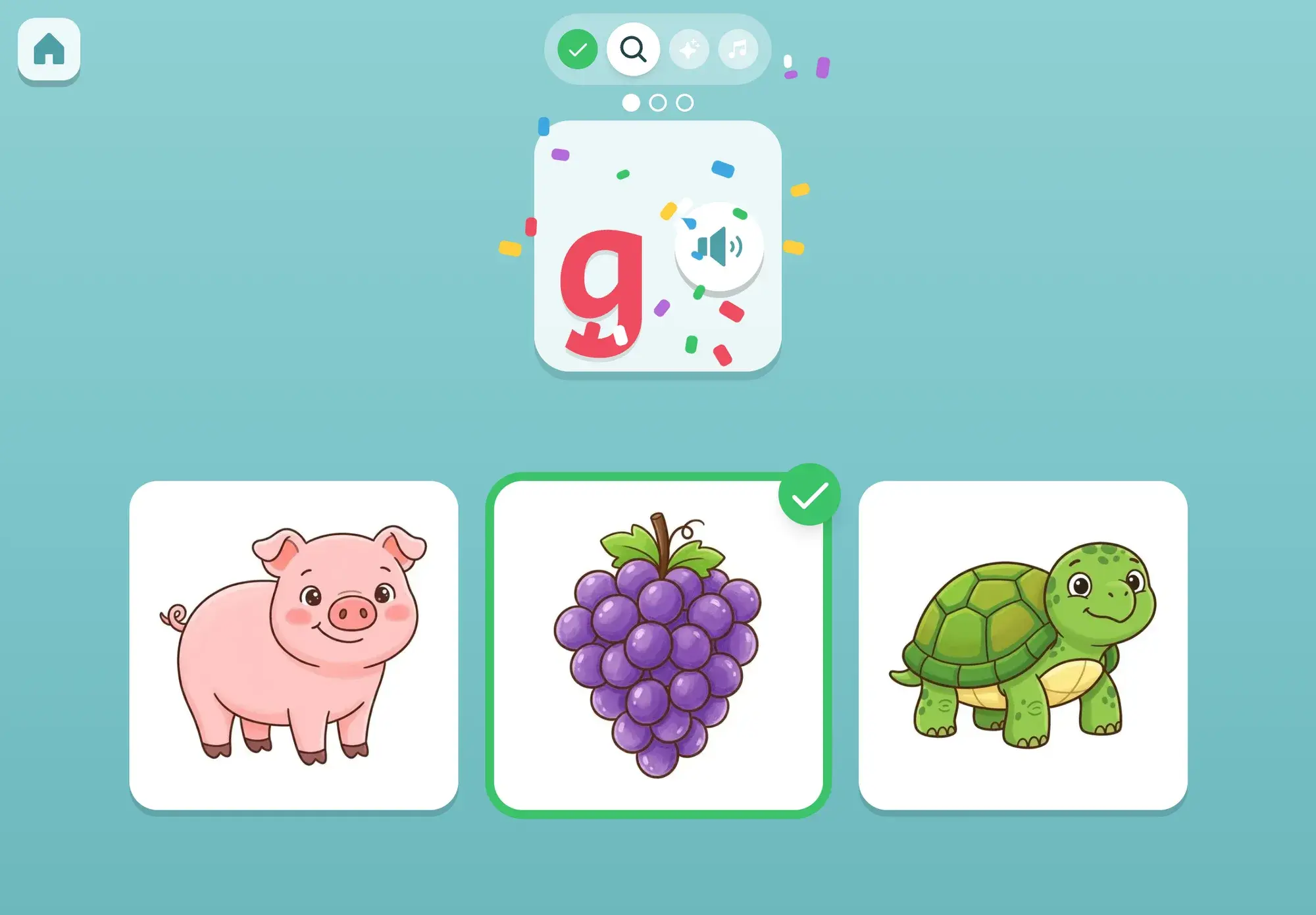
Letters and sounds in Maestri World is a path with one stop per letter sound, in the Letters and Sounds order (s, a, t, p, then i, n, m, d, and on). It teaches sounds, not letter names, and lowercase first. At each stop your child meets the letter, hears its sound, traces it with a finger from a green dot and hears it in three words. Then come a sound hunt (“Which one starts with mmm?”) and a bubble game where your child pops the bubbles with that sound. Later levels add rhyme time, clapping the beats of a word, “sound it out” (hear c... a... t and find the picture), and a word builder that puts c-a-t in order. Levels 8 and 9 bring the two-letter sounds sh, ch, th and ng, then ai, ee, oa and oo.
From level 2 there are little books where every word can be sounded out with the sounds learned so far, or is a tricky word introduced just before. A tap on a word sounds it out letter by letter, then says it. Nothing is ever failed: a wrong tap just says what it was (“Moon! mmm”). Every letter sound in the app is checked for a stray “uh” on the end.
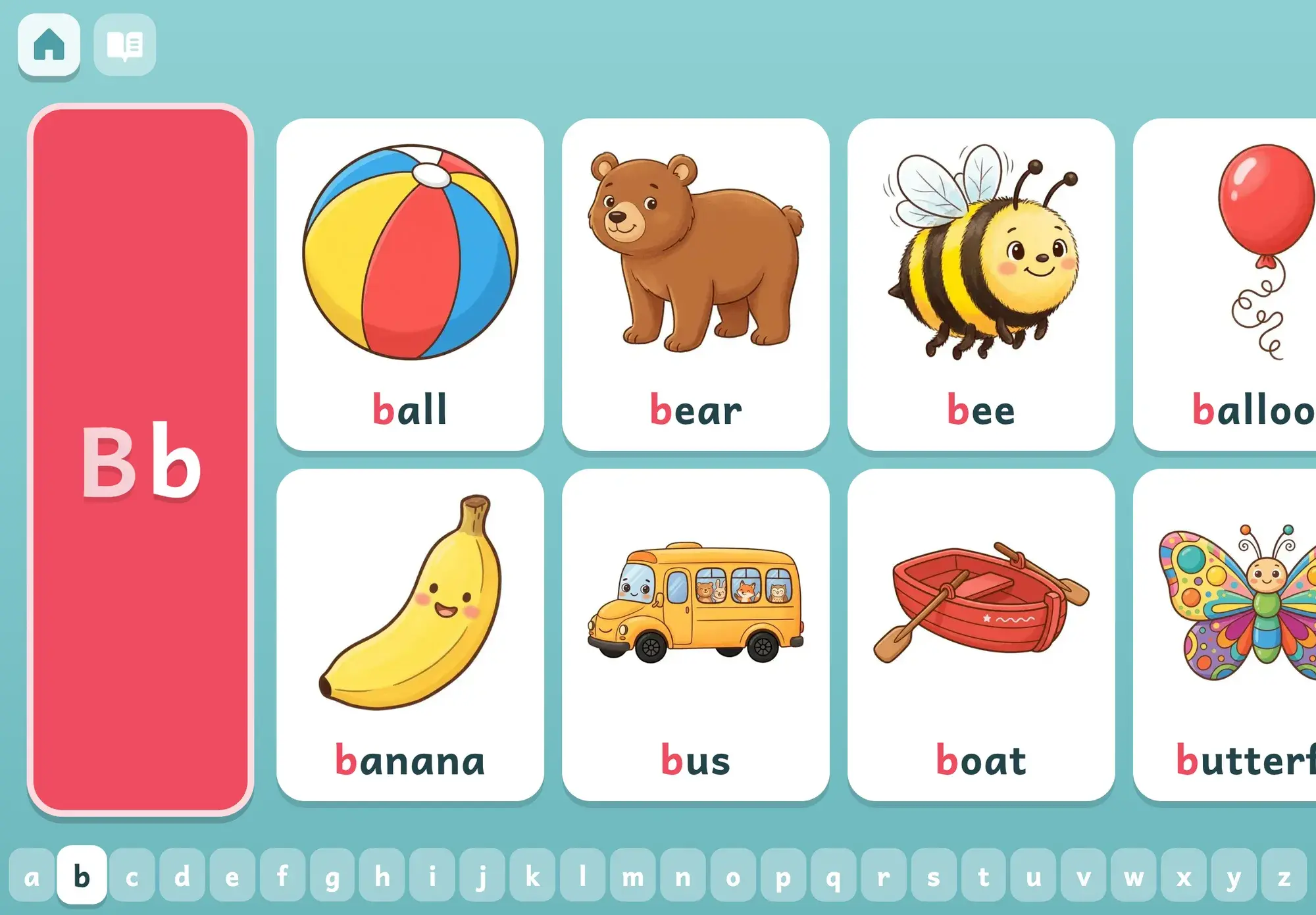
The word book is a picture dictionary from A to Z where every picture says its name. Its main rule is the clean-example rule above: a word’s first sound is always the main sound of its letter, so there’s no “k is for knife”. Letter sounds learned on the path also come back in today’s trip, the app’s short daily review, mixed with flags and numbers. You’ll find the rest of the reading games under reading games for kids, and some thoughts on fitting screens around all this in screen time for preschoolers.