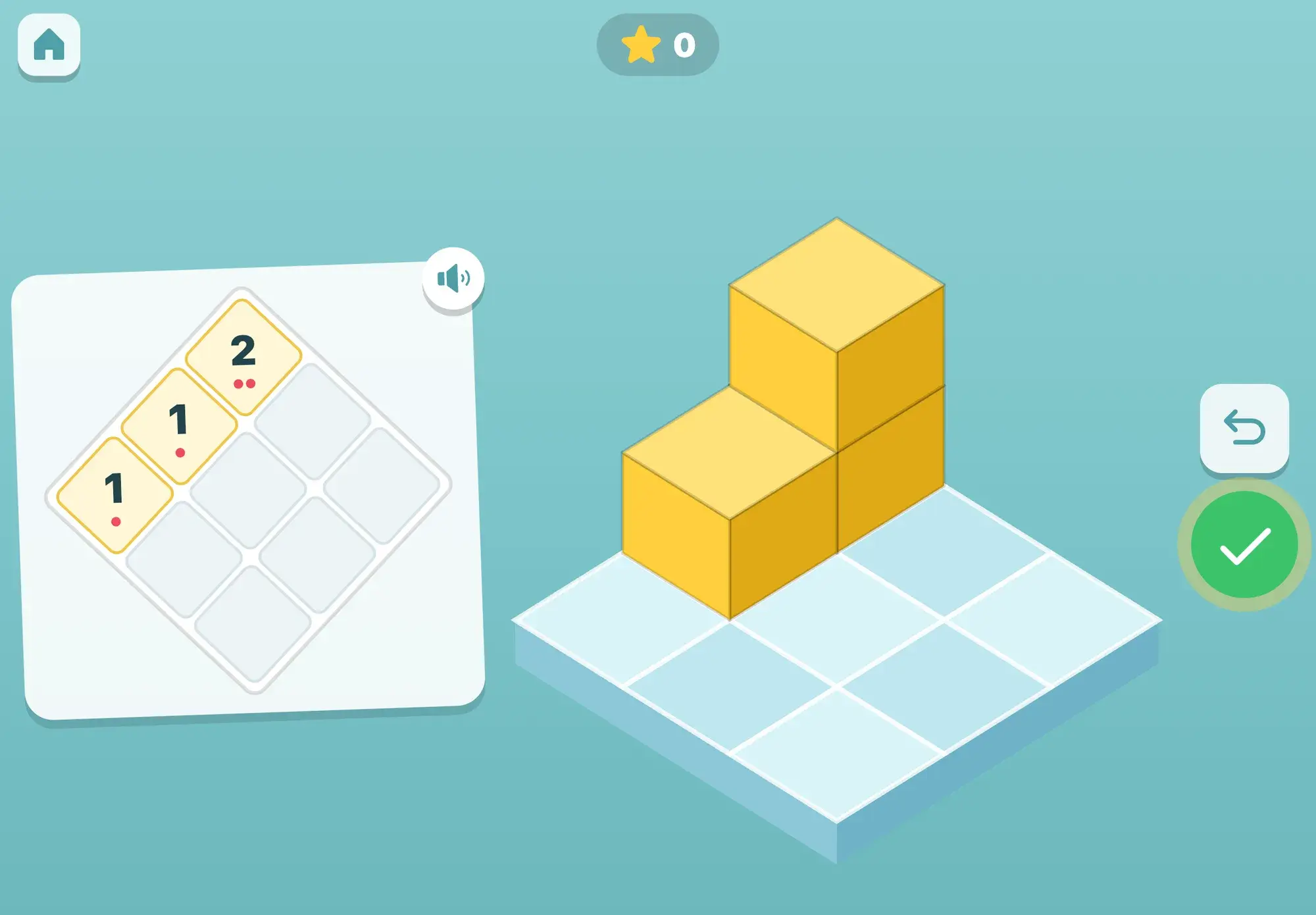
Copy the build, then build what the puppy’s camera sees from the other side
Ages 3–6Shapes & spatialBuilding & engineering
The shape studio
Six colored shapes, a tap to turn them, and pictures that can always be finished.
The shape studio is a bright art studio where your child makes pictures with pattern blocks: a yellow hexagon, a red trapezoid, a blue rhombus, a green triangle, an orange square and a purple circle, always the same color for each shape. The picture is on one side and a tray of pieces on the other. Your child drags a piece into the picture, and a tap turns it.
A piece of the right shape, turned the right way, snaps in. The right shape turned the wrong way bounces back with a turn arrow on it (“Turn it! Tap the shape to turn it.”), and that isn’t counted as a mistake. A different shape slides back with “That shape doesn’t fit there. Look at the shape of the space!”
The first time a shape is picked up, its name is explained (“A hexagon has six sides!”); after that it is just named. The pictures include a house, a rocket, a castle, a turtle, a snail and a robot, never the same one twice in a row.
How it plays
The first pictures have every piece’s place drawn in with dashed lines, and the pieces lie the way they go; a piece of the right shape even turns itself to fit. Next, some pieces lie one or two taps short of fitting, so your child has to turn them before they snap in.
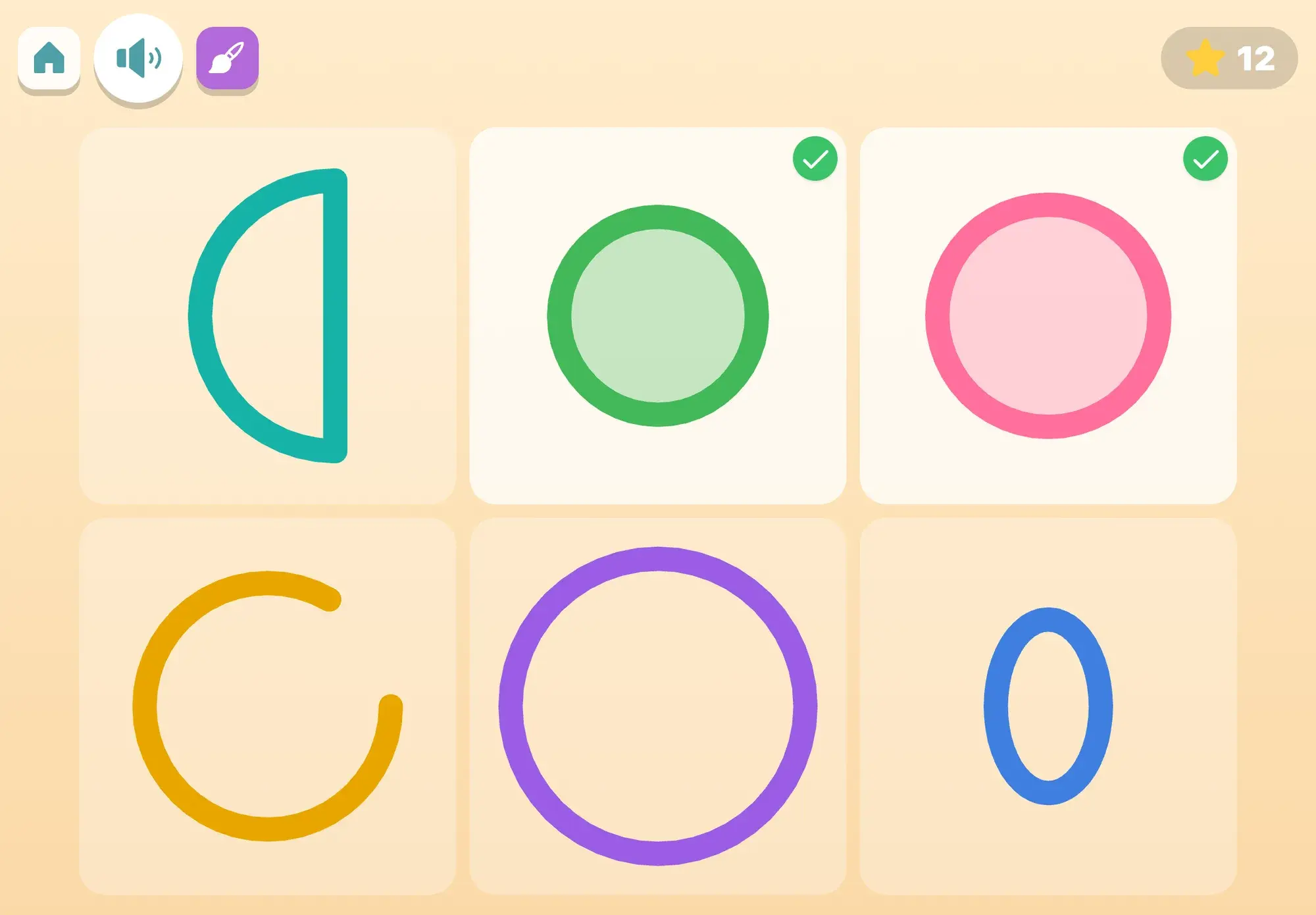
Six or eight outlines appear, and your child taps every real triangle (in later rounds every square, rectangle or circle). Real ones come in tricky looks, like a skinny or upside-down triangle or a square turned on its corner. Each fake breaks one rule, and the narrator says which: “It isn’t closed!”, a curved side, four corners.
Now the picture shows only its outline, with no lines inside, and pieces may fill it any way that leaves room for the rest. A piece that would fit but make the rest impossible bounces back with “Try another spot!”, which isn’t a mistake. After two misses with one piece, or 25 seconds without progress, its place glows.
One shape made of others: fill a hexagon with two trapezoids, three rhombuses or six triangles, or a big triangle with little ones. The tray holds more pieces than needed, and at the end they are counted out loud: “One! Two! … Six triangles make a hexagon!”
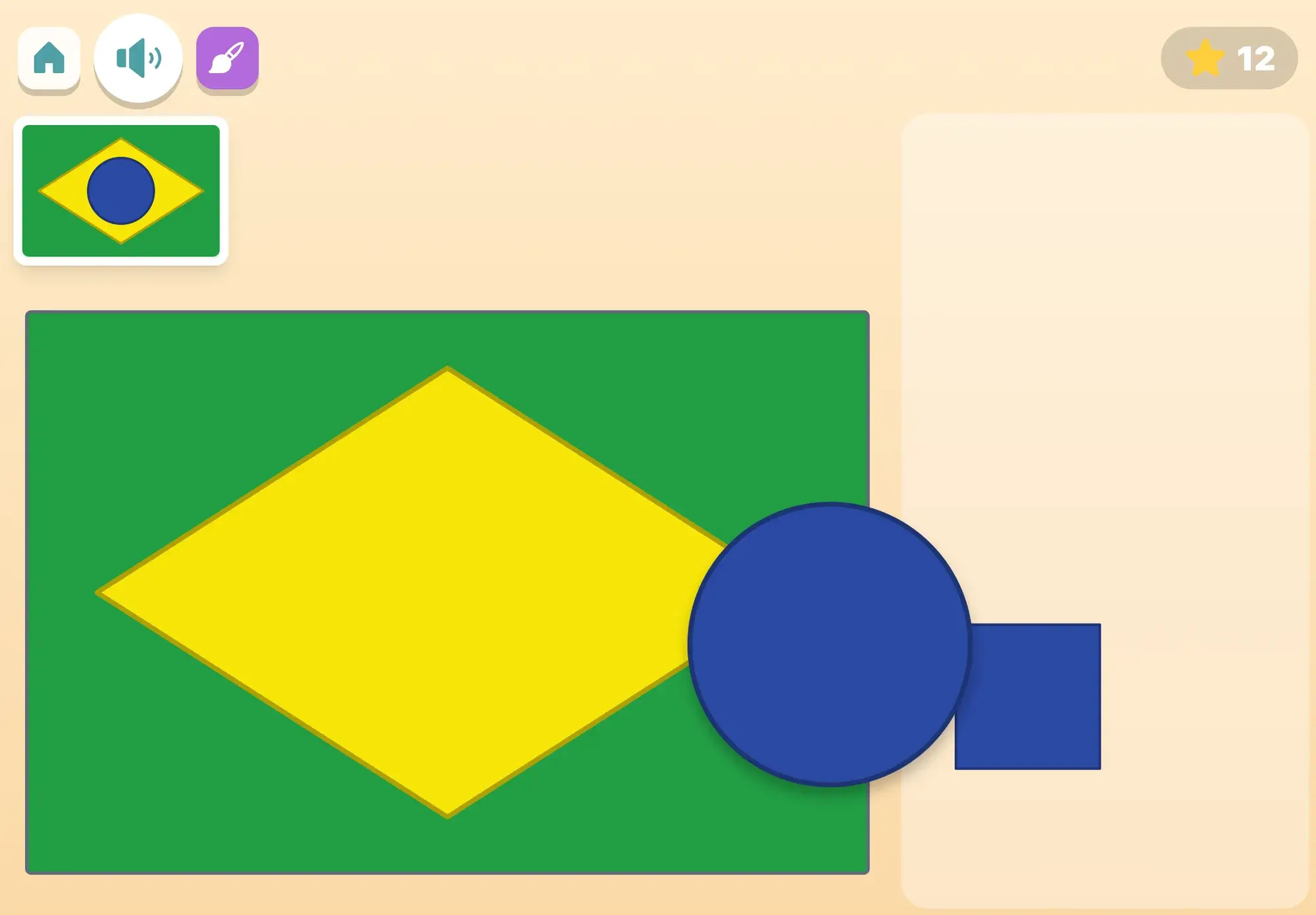
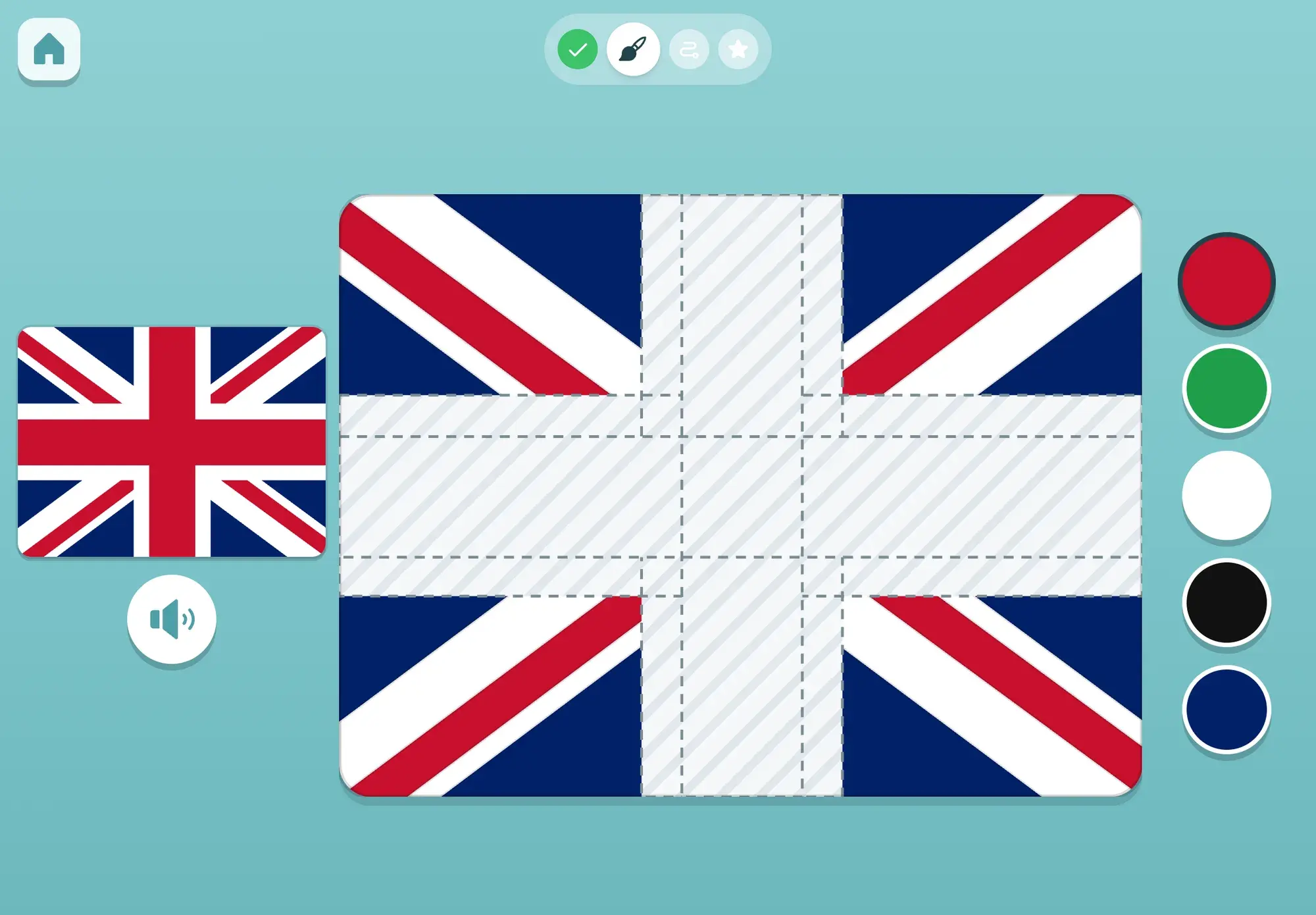
Your child copies a little flag with big shape pieces: Japan, Italy, Brazil, India, Germany, France or Peru, with countries they have learned on the trip around the world first. Stripes come lying the wrong way and need turning, and Japan’s tray has a square and a rhombus to tell from the circle. The last step brings bigger pictures with more pieces to turn.
From the fifth step on, a purple paint button opens the easel: your child’s own picture, with as many shapes as they like. Pieces settle onto a grid so they fit together, a tap turns one, and the tick keeps the picture. Up to twelve are kept, and the newest one hangs on the studio in the town.
Skills
The thinking
The steps follow the stages of shape composition, the way children learn to put shapes together, as described by Clements & Sarama: from filling drawn-in places, to turning pieces, to filling an outline with no lines inside, to seeing one shape made of others.
Many 4–6 year-olds reject a skinny or upside-down triangle (Clements et al. 1999), so the detective rounds deliberately show real shapes in tricky looks, and every fake breaks exactly one rule that the narrator names. Guided “detective” play taught shape rules better than being told (Fisher et al. 2013).
Turning the wrong way is part of the puzzle, not a mistake, so your child keeps trying turns instead of giving up. And because a picture can always be finished, there is no dead end to get stuck in.
Away from the screen
Ideas to carry the game into everyday life, no screen needed.
Go on a shape hunt around the house or down the street: windows, plates, road signs, tiles.
Draw real and fake triangles on paper (skinny ones, upside-down ones, ones with a gap or a curved side) and let your child pick out the real ones.
Cut shapes from colored paper and build a house, a rocket or a boat on the table.
Look at flags in a book or on a walk and name the shapes in them.
FAQ
It opens from age 4 in the town. The first pictures have every place drawn in and pieces that turn themselves to fit, so a younger child can still finish them.
A classic set of flat shapes in fixed colors, where the color always tells you the shape. The studio’s set is a yellow hexagon, a red trapezoid, a blue rhombus, a green triangle, an orange square and a purple circle.
It slides back to the tray. If it is the right shape turned the wrong way, a turn arrow shows on it and it doesn’t count as a mistake. Only a different shape on a space, or a flag piece of the wrong color, counts.
More to explore
Copy the build, then build what the puppy’s camera sees from the other side
Meet a country, paint its flag, drive there, and earn a passport stamp
Spoken from the first tap, no reading needed, no ads, and progress that stays on your iPad.